
Morocco had been on our travel list for years, but this trip finally gave us the perfect reason to go: our son Rhett is living in Meknes for the year while studying Arabic.
So in August, my husband Gary and I packed our carry-ons and boarded Royal Air Maroc’s new nonstop flight from Los Angeles to Casablanca. Over the next 10 days, we traveled through Morocco mostly by train, visiting Casablanca, Marrakech, Meknes, Fes and the ancient Roman ruins of Volubilis.
And I loved every single minute of it.
I’ve traveled to more than 90 countries and lived overseas for years, so I’m pretty comfortable arriving somewhere completely unfamiliar and figuring things out as I go. Morocco, however, was one of those places that immediately felt different, in the best possible way.
The colors, the smells, the calls of vendors in the medinas, beautiful riads hidden behind unassuming doors, mint tea, cats everywhere, inexpensive petit taxis, surprisingly easy train travel and some of the friendliest people we met along the way all became part of the experience.
Our itinerary wasn’t designed to check off every famous place in Morocco. We skipped some destinations entirely. Instead, we traveled at a pace that allowed us to spend several days in each place. And because Rhett lives in Meknes and speaks Arabic, we also experienced parts of Morocco that we probably wouldn’t have discovered on our own.
If you’re planning your first trip to Morocco, this is the exact route we took, what worked, what I’d change and the places I’d absolutely visit again.
Suitcase and Sunglasses includes affiliate links, which means I earn a small commission at no extra cost to you if you make a purchase through them. As an Amazon Associate I earn from qualifying purchases. Please see full disclosure on the Privacy Policy Page on suitcaseandsunglasses.com.
Day 1: Casablanca
Our trip became considerably easier when Royal Air Maroc launched its nonstop flight between Los Angeles and Casablanca in June 2026. I love getting on an airplane in one city and getting off at my destination without dealing with connections, so the new route was an easy choice.
The flight is long, but after years of flying 16-plus hours between the United States and the UAE when we lived in Dubai, it didn’t feel particularly daunting. Our aircraft was clean and new, check-in was easy and the food was surprisingly good.
We also got lucky: the flight wasn’t full, so Gary and I were each able to stretch out across an empty row and actually sleep.
And because we’re pretty good at traveling light, we didn’t check bags. Ten days in Morocco, one carry-on each.
Arriving in Casablanca Before Sunrise
Our flight landed at Casablanca’s Mohammed V International Airport very early in the morning. It was still dark outside.
After immigration, our first stop was an ATM.
Normally, I prefer not to get cash at an airport, where fees can be higher, but we knew we’d need Moroccan dirhams for our taxi into Casablanca. Convenience won.
We also knew before arriving how the airport taxi system worked, which made those first slightly jet-lagged minutes much easier.
A couple of people approached us offering private transportation, but we politely continued toward the official taxi booth outside the airport. We paid the posted, non-negotiable fare at the booth, were directed to a nearby driver and were on our way within about 10 minutes.
At 5 a.m., Casablanca was almost completely empty.
Our driver took us through the quiet streets to the Casablanca Marriott Hotel, where we’d arranged in advance for an early check-in.
That turned out to be one of the best decisions we made.
We slept for about three hours; not enough to lose the entire day, but enough to take the edge off the overnight flight. When we woke up, I felt surprisingly human. Even better, I never really suffered from jet lag for the rest of the trip.
Rhett was arriving from Meknes by train later that day, while his girlfriend was flying in from Miami, so by early afternoon our group of four was finally together.
It was time to see Casablanca.
Hassan II Mosque: Our First Stop
Our first real introduction to Morocco was a good one.
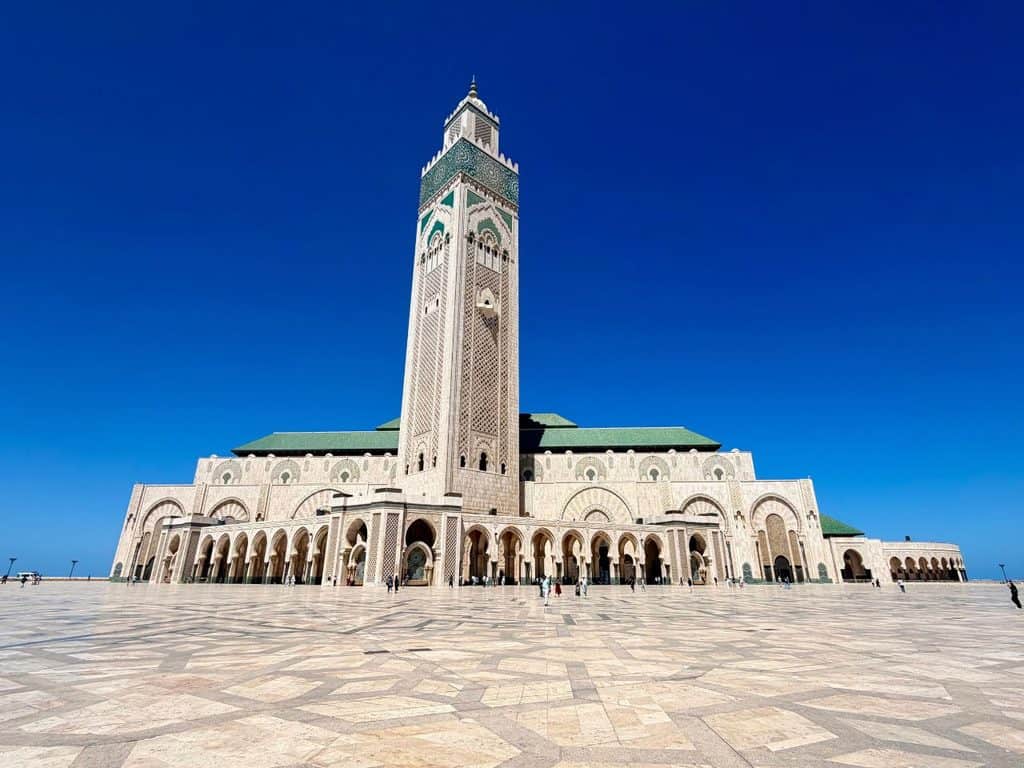
We took Casablanca’s little red petit taxis to Hassan II Mosque, the enormous mosque overlooking the Atlantic Ocean. Petit taxis quickly became one of our favorite ways to get around Morocco. They’re inexpensive, easy to find and each city has its own taxi color.
Because Casablanca’s petit taxis can carry only three passengers plus the driver, our group of four split between two cars.
Our fare?
Seven dirhams. That’s roughly 70 cents at the time.
Welcome to Morocco.
The Hassan II Mosque is spectacular from the outside, but I strongly recommend taking the guided tour rather than simply photographing it from the courtyard.
Our English-speaking guide was excellent and explained the architecture, craftsmanship and religious traditions of the mosque as we moved through the enormous complex.
My favorite part wasn’t actually the main prayer hall.
It was downstairs.
The ablution hall contains rows of beautiful marble fountains used for the ritual washing Muslims perform before prayer. I hadn’t expected this part of the mosque to be one of my favorite things we saw in Casablanca, but it was.
Our guide was also extremely impressed by Rhett’s Arabic. The two of them quickly became friends, and when we asked where we should go for good Moroccan food afterward, he didn’t just give us a restaurant name.
He walked us there.
That little interaction became our first glimpse of something we’d experience repeatedly during the trip: Moroccan hospitality.
Our First Moroccan Medina
After lunch, we decided to walk.
For about half an hour, we wandered through ordinary Casablanca streets toward the old medina. Some blocks were beautiful. Others were decidedly not. But that’s exactly why I enjoyed the walk.
This wasn’t a polished tourist district.
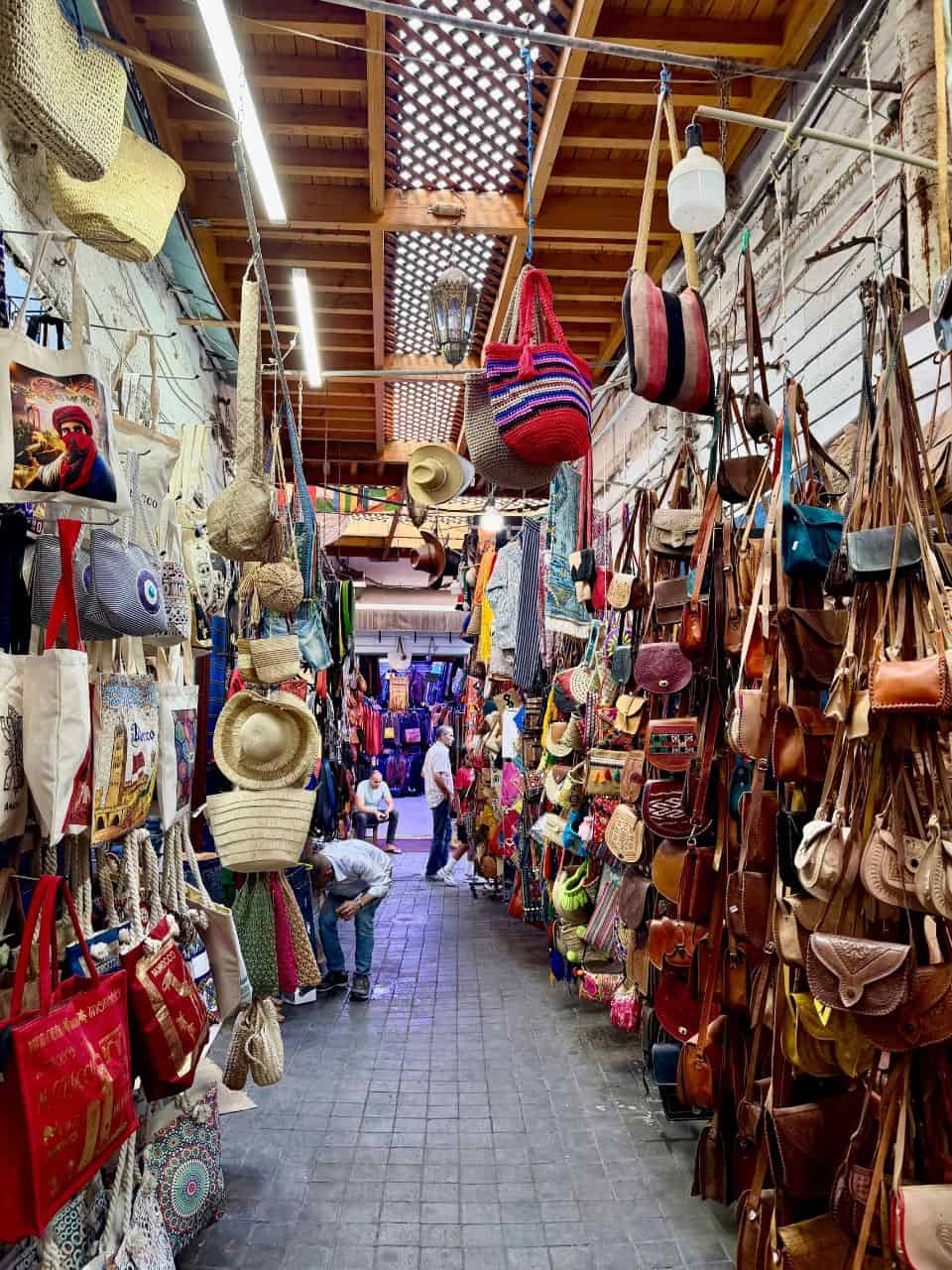
Vendors sold bunches of fresh mint, melons and oranges. Others displayed sandals, bags, household goods and even laundry detergent. People were shopping, working and going about their everyday lives.
Then we entered the medina.
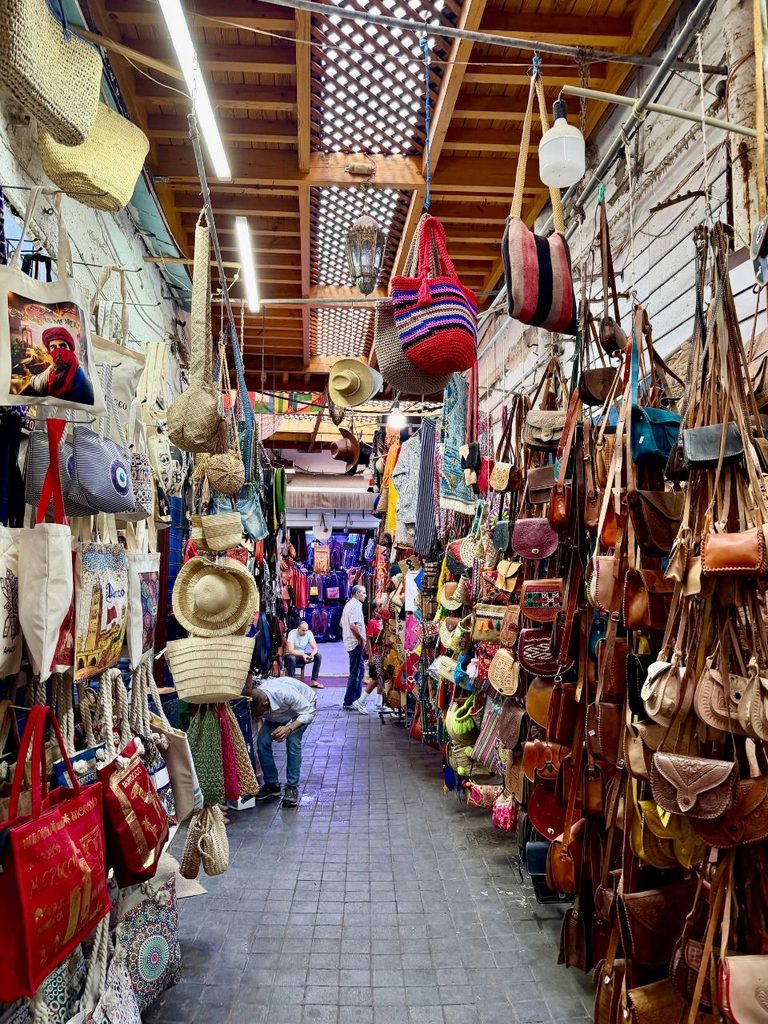
Narrow lanes twisted between tiny shops. Wooden doors leading to people’s homes appeared between storefronts. Laundry hung overhead. Spices filled the air. Vendors called out from their stalls while Rhett’s girlfriend practiced her bargaining skills on a few souvenirs.
It was chaotic, colorful and completely fascinating.
And this was only Day 1.
Casablanca After Dark
After exploring the medina, we walked back to the hotel and took about an hour to rest and clean up before heading out again.
We wanted somewhere fun for our first evening together, preferably with a rooftop where we could see the city lights. We ended up at The James Rooftop Restaurant and Bar, which was exactly what we needed after a very full first day. The restaurant was clean and lively, with a fusion-style menu, and Gary celebrated our first night in Morocco with a Casablanca beer.

But one of my favorite parts of the evening came afterward.
Walking back to our hotel reminded Gary and me of something we’d loved when we lived in the Middle East: cities can feel completely different after the sun goes down.
Casablanca had been relatively quiet during parts of the day, but now the streets were alive. Young people walked together in couples and groups. People sat on benches around the squares talking and people-watching. Cars streamed through the streets. Cats seemed to be everywhere.
It was warm but comfortable, and we weren’t in any hurry to get back.
Considering we’d landed before sunrise that morning, it was remarkable that we were still going. That three-hour nap after checking into the hotel had worked perfectly for me. We eventually returned to the Marriott, fell asleep easily and woke up the next morning ready to catch our train to Marrakech.
Is One Day in Casablanca Enough?
For us, it was.
Because our flight arrived so early, we effectively had a full day and evening in Casablanca. We saw the Hassan II Mosque, ate our first Moroccan meal, wandered through the old medina, experienced everyday neighborhoods on foot and spent the evening enjoying Casablanca after dark.
I never felt as though we were rushing through the city, but I also didn’t leave wishing we’d scheduled another full day there. For this particular 10-day Morocco itinerary, one day in Casablanca felt just right.
There is one thing I would change next time.
I’d make a reservation at the hammam at the Hassan II Mosque complex. We didn’t do it on this trip, and it’s now firmly on my list for the next one.
For first-time visitors following a similar itinerary, I’d happily recommend doing exactly what we did: arrive in Casablanca, give yourself one full day and evening to experience the city, get a good night’s sleep. Then take the train to Marrakech the following morning.
Days 2–4: Marrakech
The next morning, we said goodbye to Casablanca and headed for Marrakech.
Because there were four of us plus our carry-on bags, it was easiest to have the hotel arrange a grand taxi to Casablanca’s main train station. We’d already purchased our train tickets online before the trip, and the process had been surprisingly easy.
Our tickets arrived by email with QR codes that we simply showed to enter the platform area. In my usual overly prepared fashion, I’d also printed paper copies of everything.
We never needed them. Morocco train travel was very, very easy.
Taking the Train from Casablanca to Marrakech
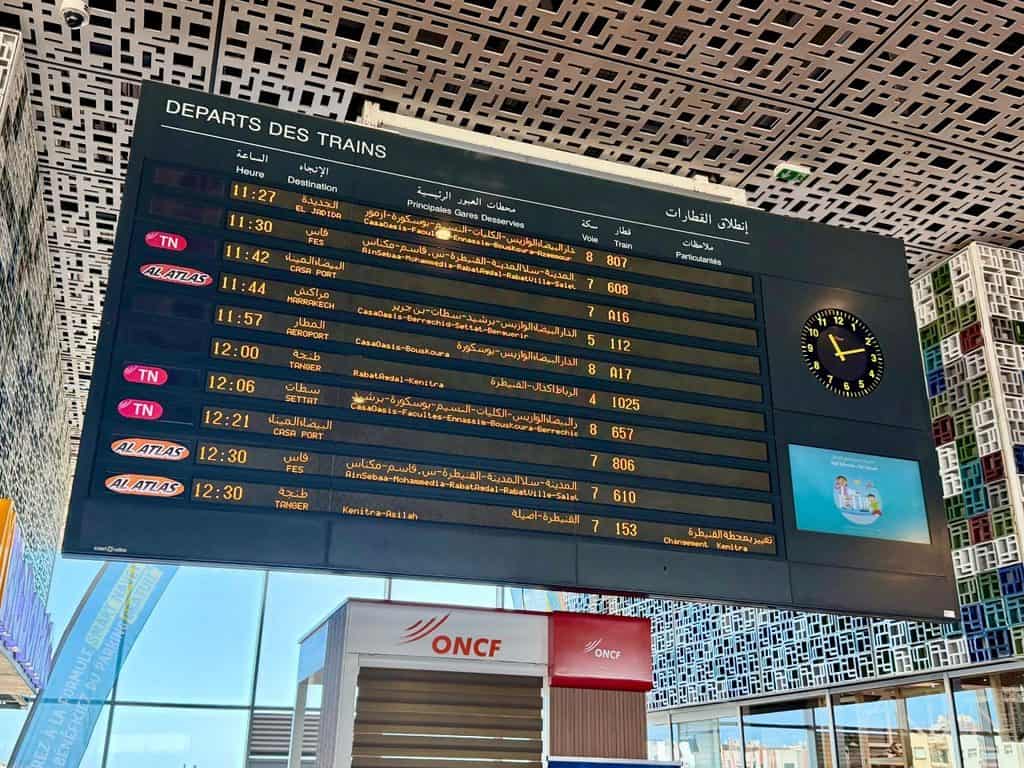
Casablanca’s train station felt like any large, modern train station. There were fast-food restaurants, shops, bathrooms, ATMs and a bank, with a large electronic board displaying departures and platform information.
Our train was running a few minutes late, which was clearly displayed on the board. When it was time to board, we showed our QR codes at the checkpoint and headed downstairs to the platform.
We’d splurged on first class for the roughly three-hour ride to Marrakech.
The price?
About $27 per person.
Our first-class compartment had six seats. The four of us shared it with two other passengers, and a food cart periodically came down the corridor selling coffee, tea, sodas and snacks.
I chose tea. When I’m traveling, I like knowing the water has been boiled, and I’ve never been much of an instant-coffee fan anyway.
I loved this train ride.
The scenery kept changing outside the window: coastal landscapes gave way to agricultural areas, then dry and rocky terrain, a river that seemed to appear out of nowhere, more farmland and finally increasingly dusty landscapes as we approached Marrakech.
Towns and Villages Along the Way to Marrakech
But what I enjoyed most was watching the small towns and villages go by.
This was Morocco far beyond the tourist centers we’d come to see: fields, homes, villages and people going about their everyday lives. Train travel gave us a glimpse of the country we never would have seen from an airplane.
By the time we arrived in Marrakech, I was already sold on traveling Morocco by train.
Morocco travel tip: If you’re traveling between cities connected by rail, don’t automatically assume you need a private driver. We found Morocco’s trains comfortable, inexpensive and remarkably easy to use. I share everything we learned about buying tickets, choosing first class and navigating the stations in my complete Morocco train guide.
Arriving in Marrakech
Marrakech station was busier than Casablanca, but it was still easy to navigate.
We could have walked a block or so away from the station and hailed a less expensive taxi. Twenty-something-year-old me absolutely would have done that.
But it was warm, we had our luggage, and the taxi from the station wasn’t particularly expensive anyway.
Sometimes convenience wins.
We took a grand taxi directly to Le Méridien N’Fis, where we’d be staying for our three nights in Marrakech.
We’re longtime Marriott travelers, and this is one of those situations where loyalty to a hotel chain can really pay off. Over the years we’ve earned status, which now often means upgrades, breakfast or other perks when we travel. At Le Méridien, our status gave us access to the M Lounge, where complimentary food and drinks were available in the afternoon.
The hotel’s location also worked extremely well for us. It was about a mile’s walk straight to Jemaa el-Fnaa, the famous square at the entrance to Marrakech’s enormous medina.
We checked in, freshened up and headed toward the action.
First Impression of the Marrakech Medina: Holy Moly
I’ve wandered through some pretty impressive markets in my travels, including Khan el-Khalili in Cairo and Istanbul’s Grand Bazaar.
Marrakech was something else entirely.
It felt like a city within a city within another city.
The lanes twisted and turned, narrowed and widened, then suddenly opened into beautiful courtyards before disappearing into another maze of shops.
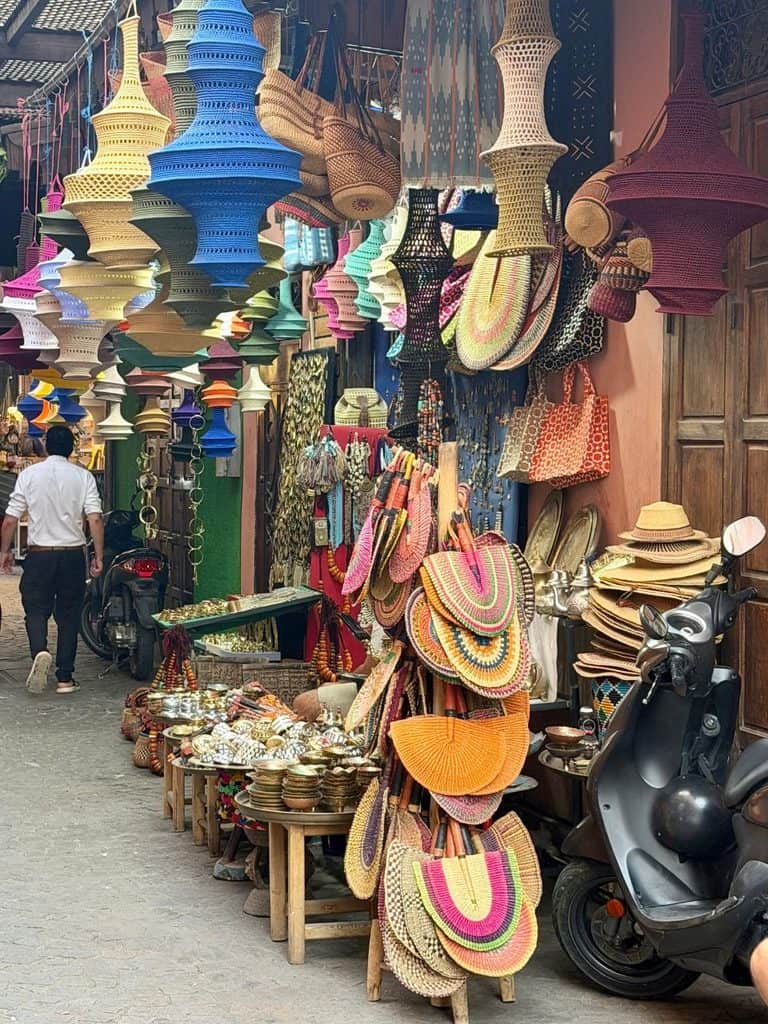
Carpets. Perfume. Spices. Pharmacies. Juice stalls. Restaurants. Mosques. Schools. Cats. Carts. Locals. Tourists. Men and women negotiating over merchandise.
And mopeds.
So. Many. Mopeds.
They buzzed through impossibly narrow passages, sometimes coming so close that I genuinely don’t know how we weren’t run over.
I was completely in my element.
One thing I quickly realized was that the medina isn’t simply a tourist attraction or shopping district. People live here. Behind many of the beautiful wooden doors we passed were private homes and riads, and I constantly found myself wondering what was on the other side.
We wandered for hours before eventually finding our way back to Jemaa el-Fnaa.
Snakes, Mint Tea and Rhett’s $1 Haircut
The square was an experience all by itself.
Restaurants and juice stalls surrounded the activity, and then there were the famous snake charmers.
I’m conflicted about this particular Marrakech tradition and wouldn’t personally seek it out as an animal experience. Nevertheless, it remains part of the scene visitors encounter in Jemaa el-Fnaa.
Before we quite knew what was happening, Rhett had two snakes draped around his neck while two cobras sat in front of him.
Yes, I have photos.
We eventually escaped the chaos and found an outdoor restaurant terrace overlooking the square, where I ordered yet another Moroccan tea and happily watched everything happening around us.
Later, Rhett spotted a barber in the souq and, completely on a whim, decided to get a shave.
It cost him roughly a dollar.
It was one of those tiny, completely unplanned travel experiences that we still talk about.
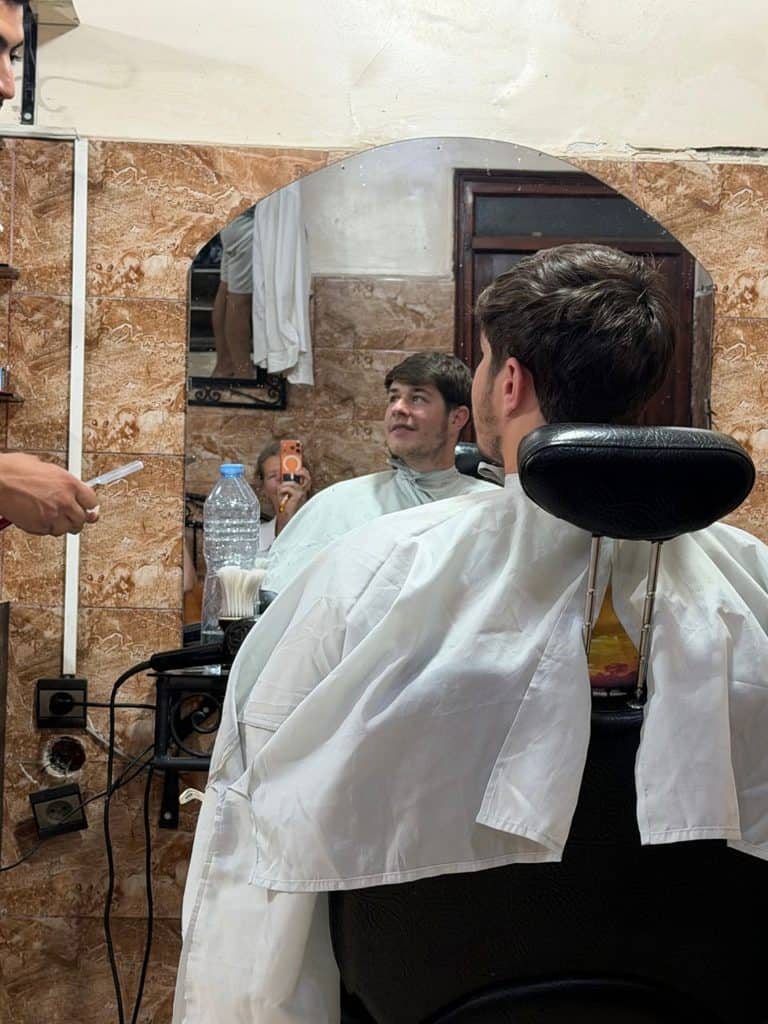
Our son stopped for a haircut in the medina for about $1.
That evening, we had dinner at Le Bistro Arabe on the edge of the main square before finally calling it a night.
Marrakech had already lived up to the hype.
Day 3: Gardens, Shopping—and Actually Relaxing
The following morning, we split into two petit taxis and headed to Le Jardin Secret.
This was one of my favorite quieter discoveries in Marrakech.
After the sensory overload of the medina, stepping into the gardens felt like entering another world. Beautiful courtyards were filled with olive and citrus trees, and the surrounding architecture gave us our first real look at the traditional design hidden behind so many of those doors we’d passed the day before.
And the tilework.
I love Portuguese tile and have admired it on several trips, but Morocco gave it some serious competition.
I could have photographed the tiles, carved doors, windows and architectural details all day.
Afterward, we returned to the souq for more wandering and shopping. Rhett and his girlfriend bought traditional scarves and received numerous demonstrations and opinions about exactly how they should be worn.
Then we did something rather unusual for us on a trip.
We stopped sightseeing.
We went back to the hotel and spent a couple of hours at the pool.
And it was wonderful.
This trip ended up having just the right balance between seeing as much as we could and actually enjoying where we were. It was also Rhett’s week off between school terms, so he understandably wasn’t looking for his parents to turn his vacation into a dawn-to-midnight sightseeing marathon.
That evening we returned toward Jemaa el-Fnaa for dinner at Le Marrakchi.
Our table overlooked the square through a beautiful decorative window, which naturally resulted in far too many photos.
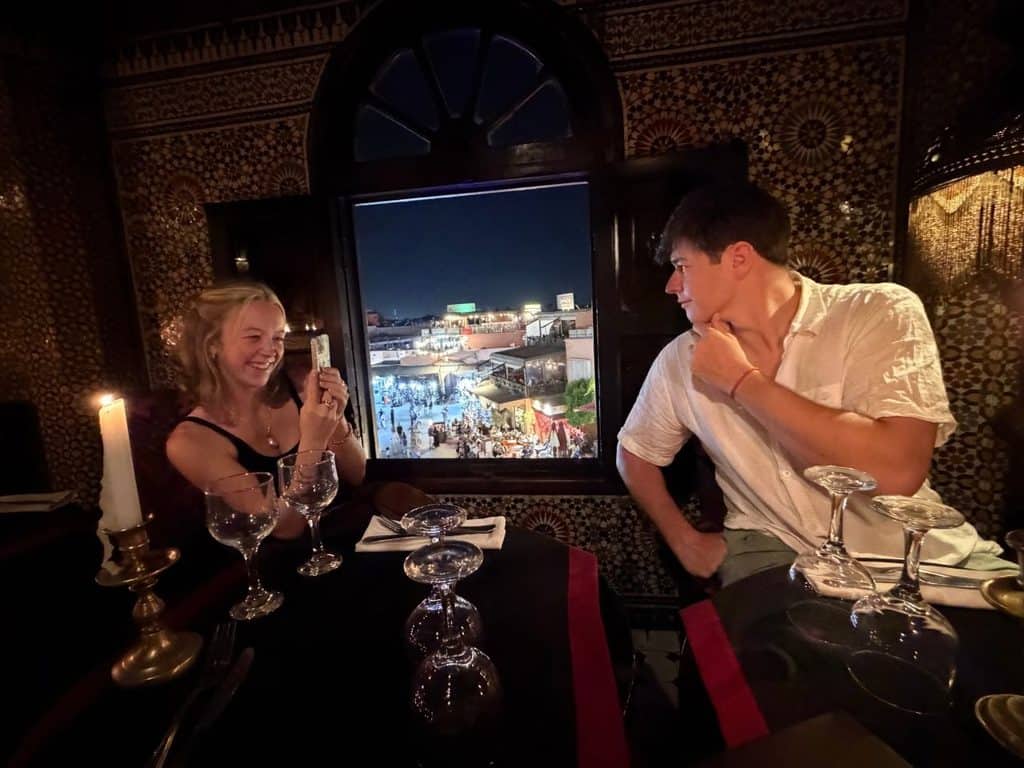
Some places make you want to put the camera away.
Marrakech was not one of those places.
Day 4: Bahia Palace and an Evening in the Agafay Desert
On our final morning in Marrakech, we found a bakery and bought an assortment of Moroccan sweets before heading to Bahia Palace.
If you love Moroccan architecture, tilework, carved doors, courtyards, color and gardens, put this one on your list.
By this point, I’d taken hundreds of photos in Marrakech, and Bahia Palace didn’t help my photo problem.
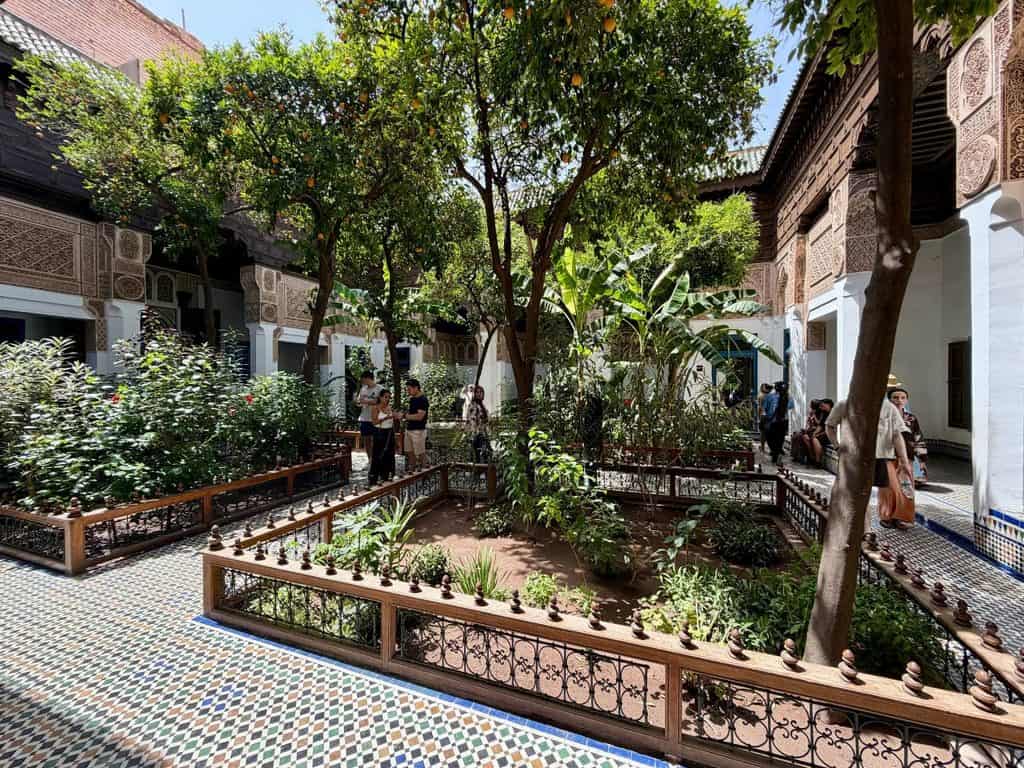
After touring the palace, we returned to the hotel for a quick break because our final Marrakech experience would take us outside the city.
We were going to the Agafay Desert.
Camel Ride, Dinner and Sunset in Agafay
I’ll admit it: I expected this excursion to be expensive and probably a little too touristy.
It was touristy.
It was also ridiculously fun.
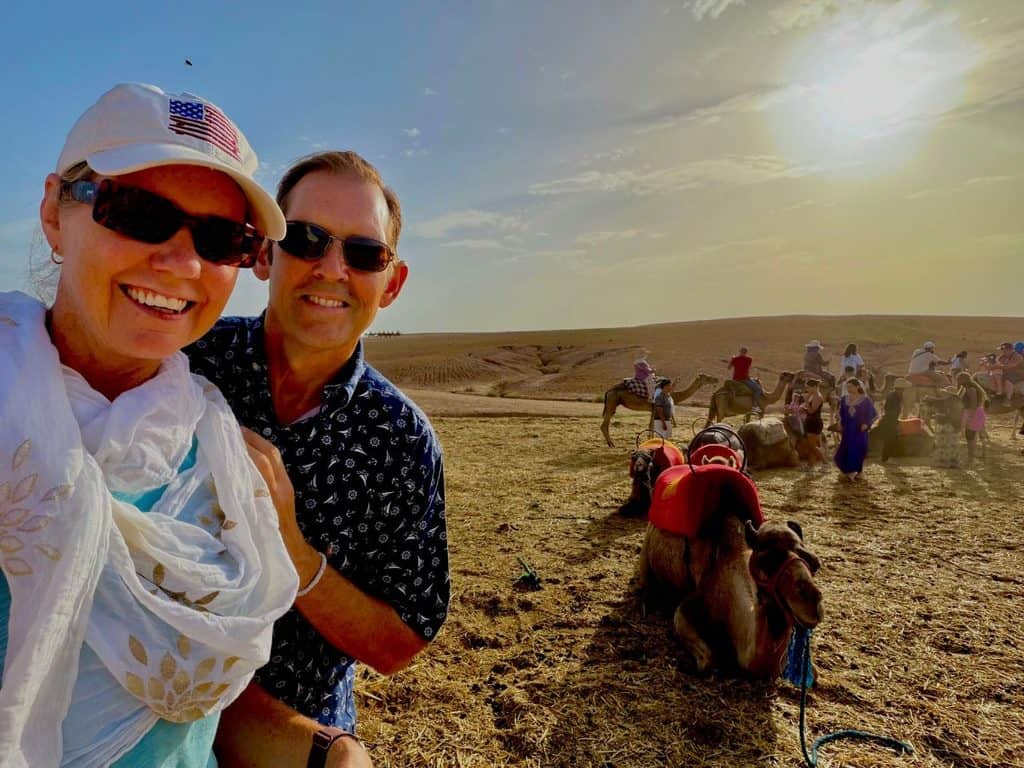
A van picked us up and took us outside Marrakech into the rocky Agafay landscape. Our evening included a camel ride, dinner, traditional music and entertainment, and an absolutely beautiful sunset.
Rhett’s girlfriend had never ridden a camel before, which made it even more fun for our group.
And I couldn’t stop taking pictures.
The biggest surprise was the price. Our entire evening for four people cost less than $60 at the time.
Transportation, camel ride, dinner and entertainment.
For all four of us.
This was one of those times when doing the obviously touristy thing was absolutely worth it.
Are Three Days in Marrakech Enough?
For us, yes.
Could we have found more things to do in Marrakech? Absolutely.
But I wouldn’t have wanted to cram much more into these three days.
The medina itself deserves time. It’s not a place I’d recommend rushing through with a checklist. Some of my favorite moments came simply from wandering, getting slightly lost, stopping for tea, looking through shops and seeing what was around the next corner.
We balanced that chaos with quieter places like Le Jardin Secret and Bahia Palace, gave ourselves an afternoon by the pool and finished with a fun evening excursion into the Agafay Desert.
Three nights gave us enough time to experience Marrakech without becoming exhausted by it.
And by the following morning, we were ready for another train ride.
This time, we were headed to the reason we’d come to Morocco in the first place.
Meknes.
Planning a Trip to Morocco? I’m creating a whole series of firsthand Morocco travel guides, including trains, riads, Marrakech, Meknes, Fes, packing tips and more.
Get My Morocco Travel Guides →
Day 5: Marrakech to Meknes — A Completely Different Morocco
After three days in Marrakech, we boarded another train, this time for the much longer journey to Meknes.
The trip took a little over six hours, first backtracking toward Casablanca and then heading east through a completely different part of Morocco.
Once again, we’d purchased inexpensive first-class tickets, and once again, I loved traveling this way.
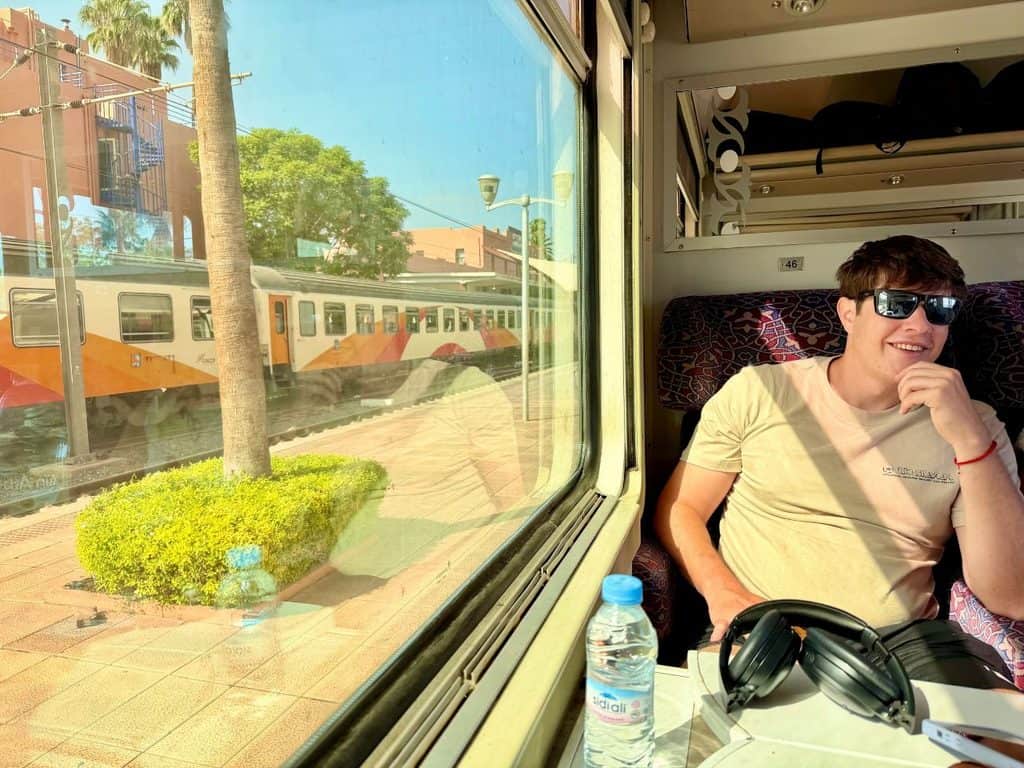
The train passed through Rabat, Morocco’s capital, and what I could see from the window immediately made me want to return. We went around and through parts of the city, and I kept looking out the window thinking, We need to come back here.
Another trip.
From Rabat, we continued east through new countryside until we finally arrived in Meknes.
And almost immediately, I knew this was going to be different.
Our First Impression of Meknes
Meknes didn’t feel anything like Marrakech.
We saw virtually no tourists.
This was a busy, everyday Moroccan city, and one I quickly realized had an extraordinary history hiding in plain sight.
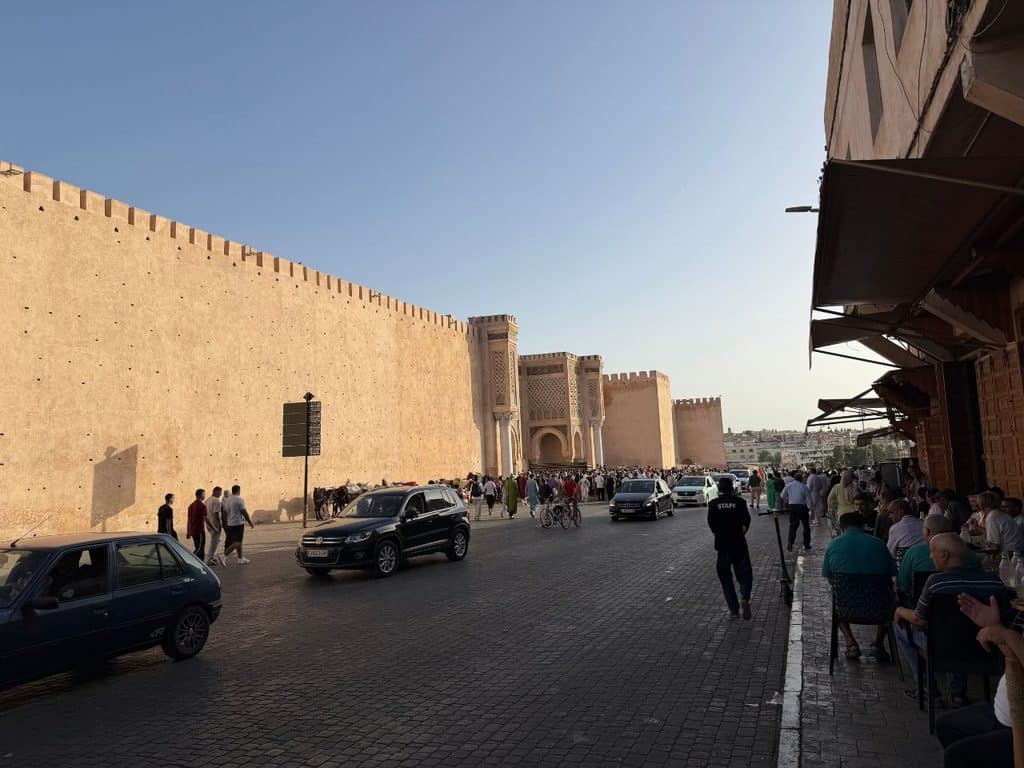
Meknes is also the reason Rhett is living in Morocco. He’s there studying Arabic and, specifically, Darija, the Moroccan Arabic dialect he’d been hearing and speaking every day.
At the train station, Rhett and his girlfriend headed back to his apartment while Gary and I took a petit taxi toward the old medina.
And for once, I had deliberately not booked us into a Marriott.
I wanted a traditional Moroccan riad.
I’m so glad I did.
Sleeping Inside the Ancient Walls of Meknes
We’d booked three nights at Riad Zidania, tucked inside the historic medina of Meknes.
And when I say inside, I really mean inside.
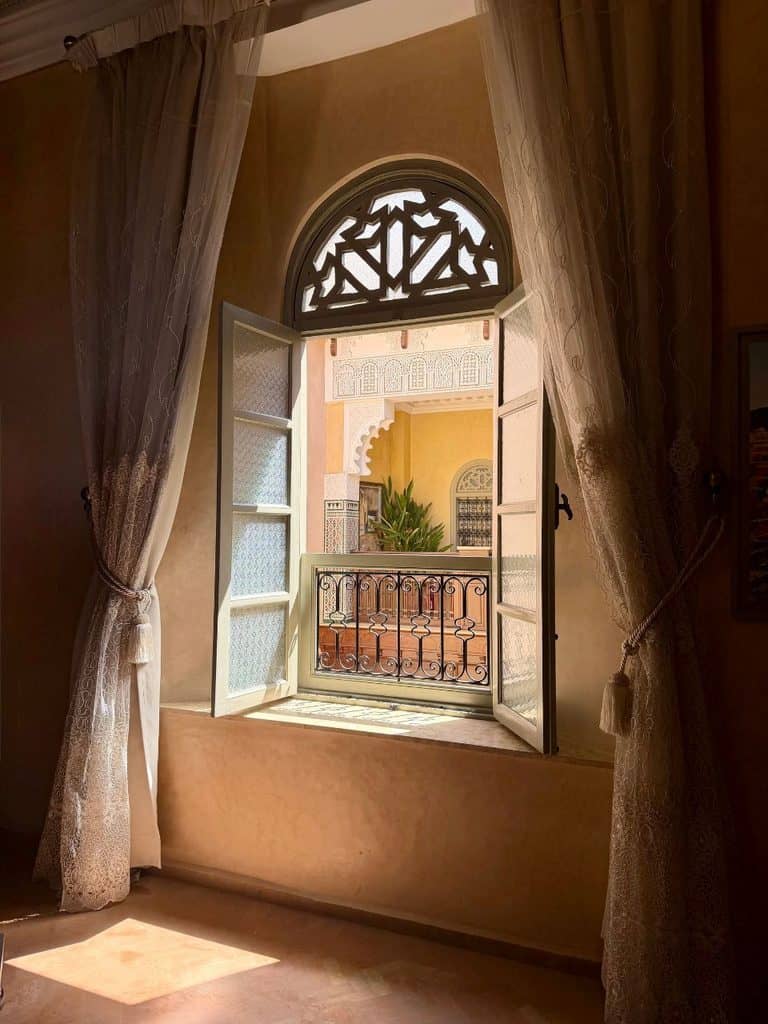
Meknes’ historic city is surrounded by enormous walls and fortifications. Our riad was located within those walls, and part of the ancient wall itself formed a wall of our room.
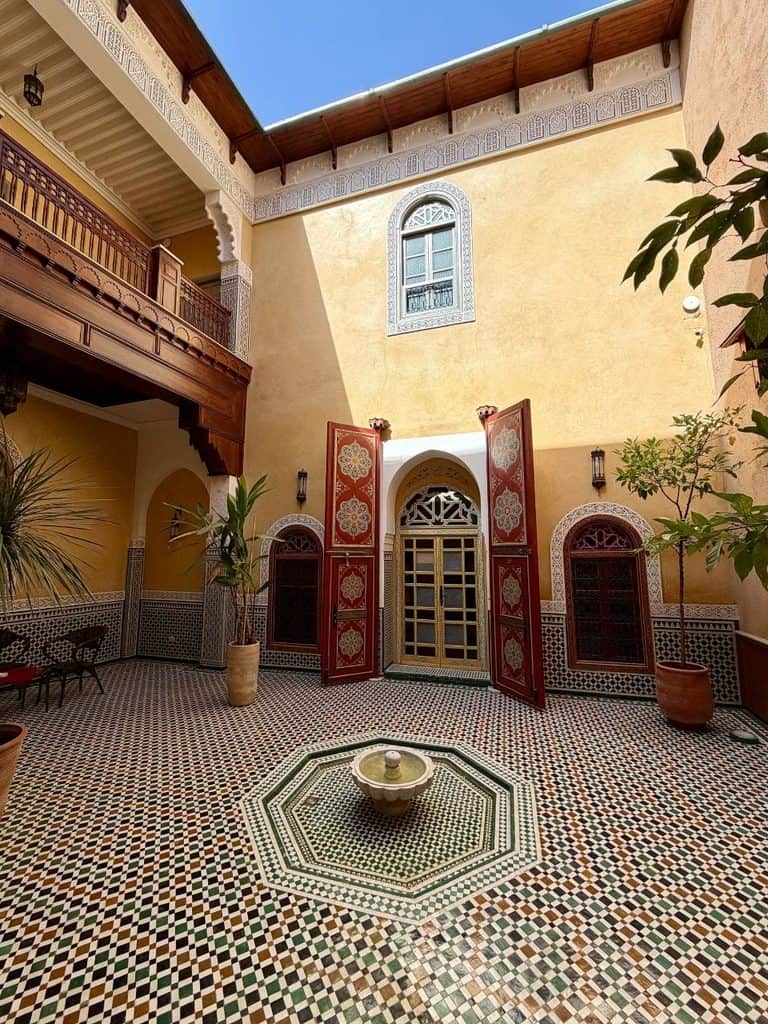
The wall behind my head while I slept was part of historic Meknes.
As a former history teacher, I thought this was ridiculously cool.
For days, I’d been walking through Moroccan medinas staring at beautiful wooden doors and wondering what was hidden behind them.
Now I finally got to find out.
We were staying behind one.
Our riad was simple but beautiful, with a clean room, private bathroom and shower, wonderful hospitality and breakfast included. Even better was the location. We were directly across a narrow alley from the Mausoleum of Moulay Ismail and only a short walk from Bab Mansour and Place el-Hedim.
I’d wanted a completely different experience from our stays in Casablanca and Marrakech.
That’s exactly what we got.
Seeing Rhett’s Life in Meknes
After getting settled, Gary and I gave Rhett and his girlfriend some time to get back to his apartment and unpack. Later, we arranged to meet near a park outside the medina.
From there, Rhett took over as our guide.
He led us through the narrow streets to his school, tucked away behind an orange tree.
This was one of those parts of the trip that wouldn’t appear on anyone else’s Morocco itinerary, but for us, it was one of the reasons we’d traveled halfway around the world.
We finally got to see where Rhett spends his days.
The security guard welcomed us, and before long he was opening classrooms so we could look around.
Gary and I were also getting our first real glimpse of just how comfortable Rhett had become communicating in Arabic.
We’d see that again and again over the next few days.
A Souq Without the Tourists
Next, Rhett led us into the Meknes medina.
I couldn’t believe it.
After Casablanca and especially Marrakech, I’d started to think I understood Moroccan souks.
Then came Meknes.
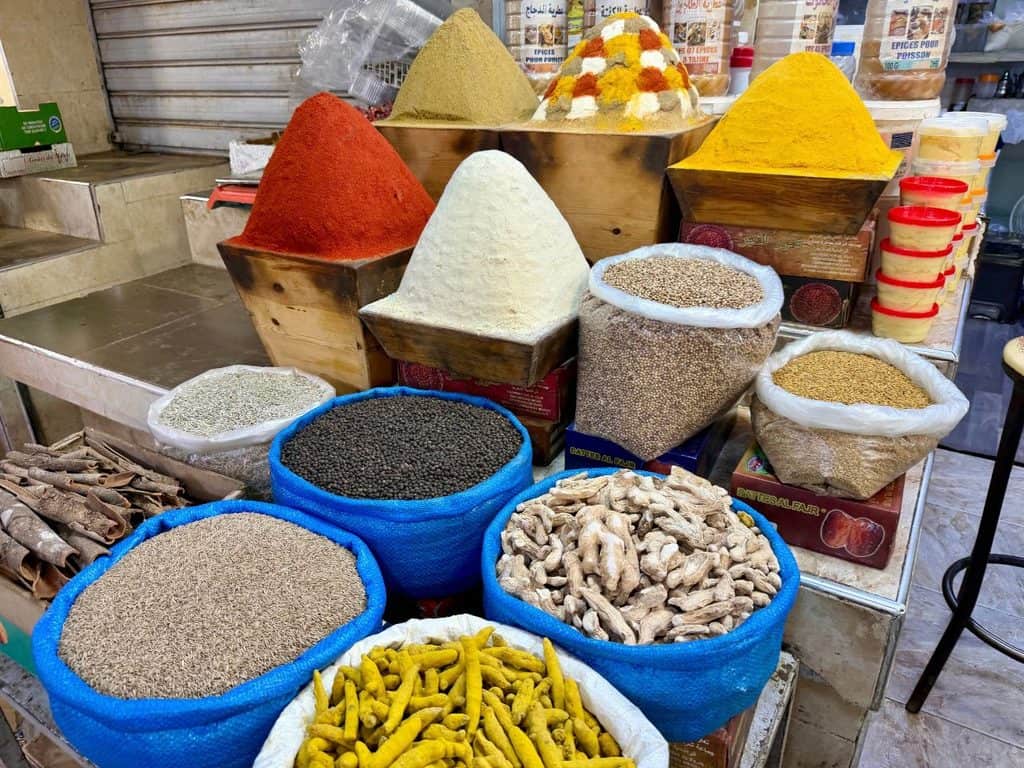
The market twisted through another seemingly impossible maze of narrow lanes filled with spices, sweets, fabrics, clothing, food, tea and everyday necessities.
But something was missing.
Tourists.
We hardly saw any.
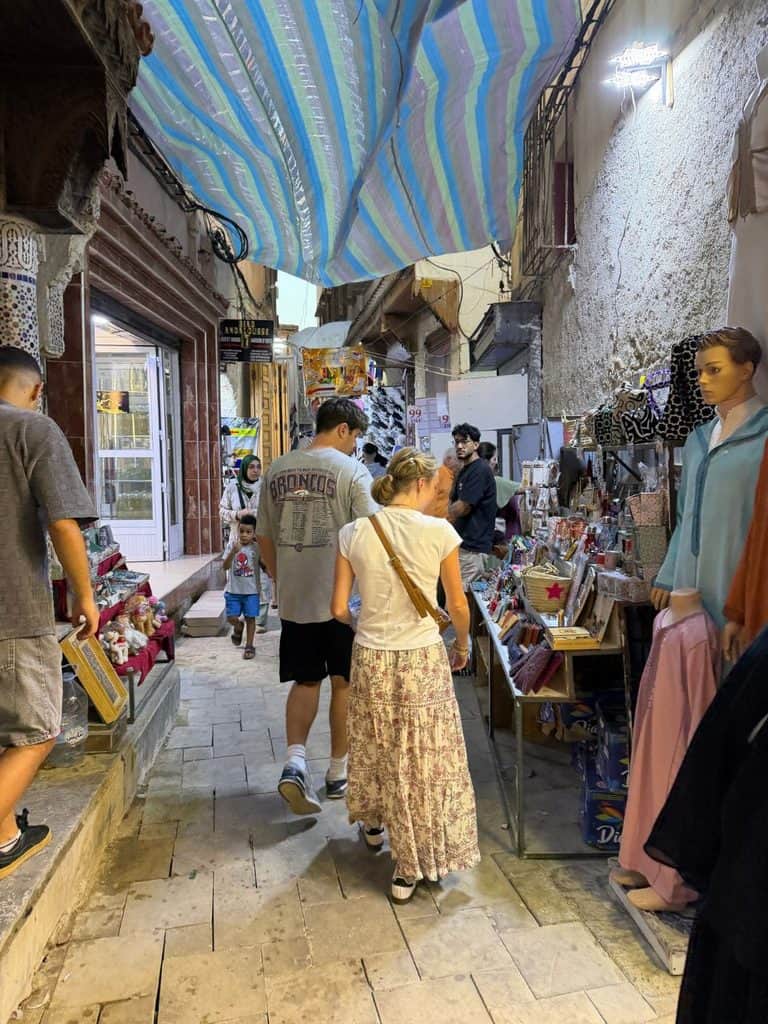
People weren’t there putting on a show for visitors. They were shopping for dinner, buying clothes, picking up sweets and going about their everyday lives.
We were very clearly the odd ones out.
And then Rhett would start speaking Arabic.
That usually produced a wonderful reaction.
People would look at him, look at us, and try to figure out exactly what this strange group was doing there.
I loved it.
We weren’t particularly interested in shopping that afternoon, so we simply followed Rhett through the maze as he led us uphill.
Eventually we emerged from the medina surprisingly close to our riad.
I still wasn’t entirely sure how we’d gotten there.
Place el-Hedim on a Holiday
We’d also arrived in Meknes at an unusually good time.
A religious celebration was taking place, and Place el-Hedim, the enormous square beside the medina, was absolutely packed.
Music played. People gathered in huge groups. Ceremonial objects were carried through the square. Families were celebrating, watching and enjoying the evening.
At times there were so many people that it was difficult to move.
I loved it.
I can also understand how someone uncomfortable in very large crowds might find the experience overwhelming. But for us, stumbling into a genuine local celebration rather than something staged for tourists was incredibly memorable.
Eventually, we escaped the crowds in search of dinner.
Gary had apparently developed a Morocco rooftop-restaurant requirement by this point, so we ended up at Yuba for dinner overlooking Meknes.
Then we made our way back through the old city to our riad.
We’d been in Meknes for less than a day.
I already loved it.
Day 6: Volubilis — Roman Ruins Among the Olive Groves
The following morning, we set out for one of the places I’d been most excited to see: the ancient Roman city of Volubilis.
Getting there from Meknes was surprisingly easy.
We walked to the grand-taxi departure area and negotiated with a driver to take the four of us to Volubilis, wait while we explored the ruins, and then drive us back to Meknes.
Simple. Inexpensive. And much easier than I’d expected.
The drive itself was beautiful.
As we left Meknes, we passed grove after grove of olive trees. Some looked incredibly old, which felt appropriate considering where we were headed.
Then, about 30 kilometers outside Meknes, we arrived at Volubilis.
Why Volubilis Was One of My Favorite Places in Morocco
I love ruins.
I especially love ruins where you can actually wander, look closely at things and imagine what life there might have been like.
Volubilis was exactly that kind of place.
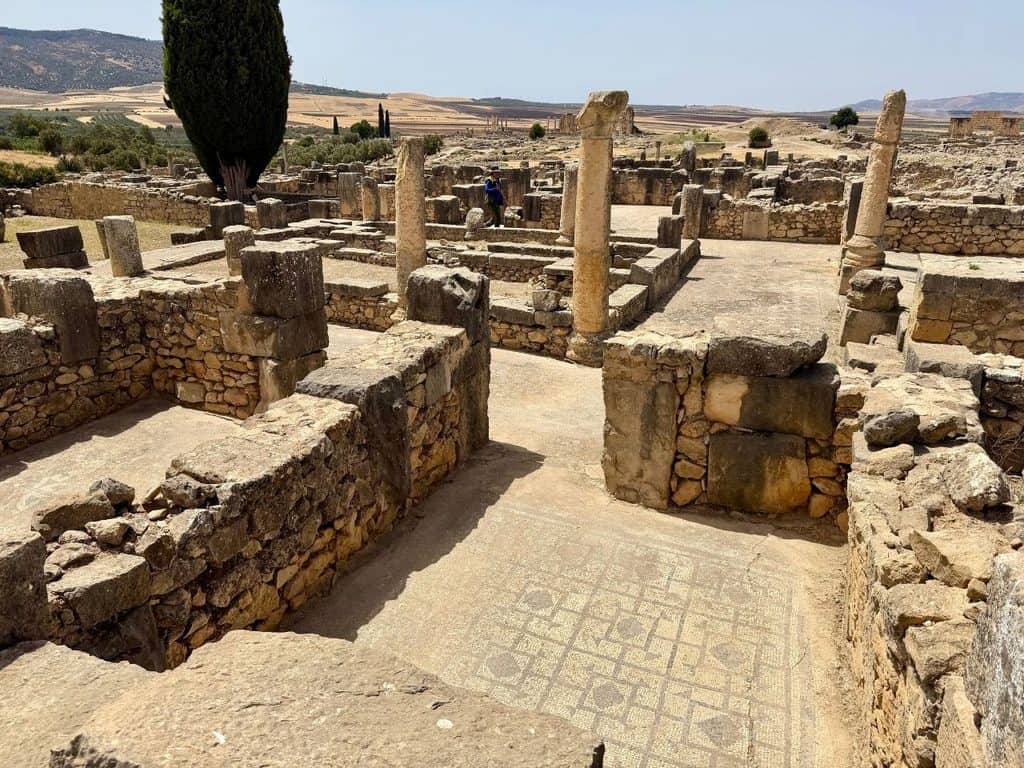
This had once been a prosperous Roman city, and the scale of what remains is remarkable.
We walked along actual Roman streets where drainage channels are still clearly visible. We explored the remains of enormous homes that once belonged to wealthy residents, complete with courtyards and room after room arranged around them.
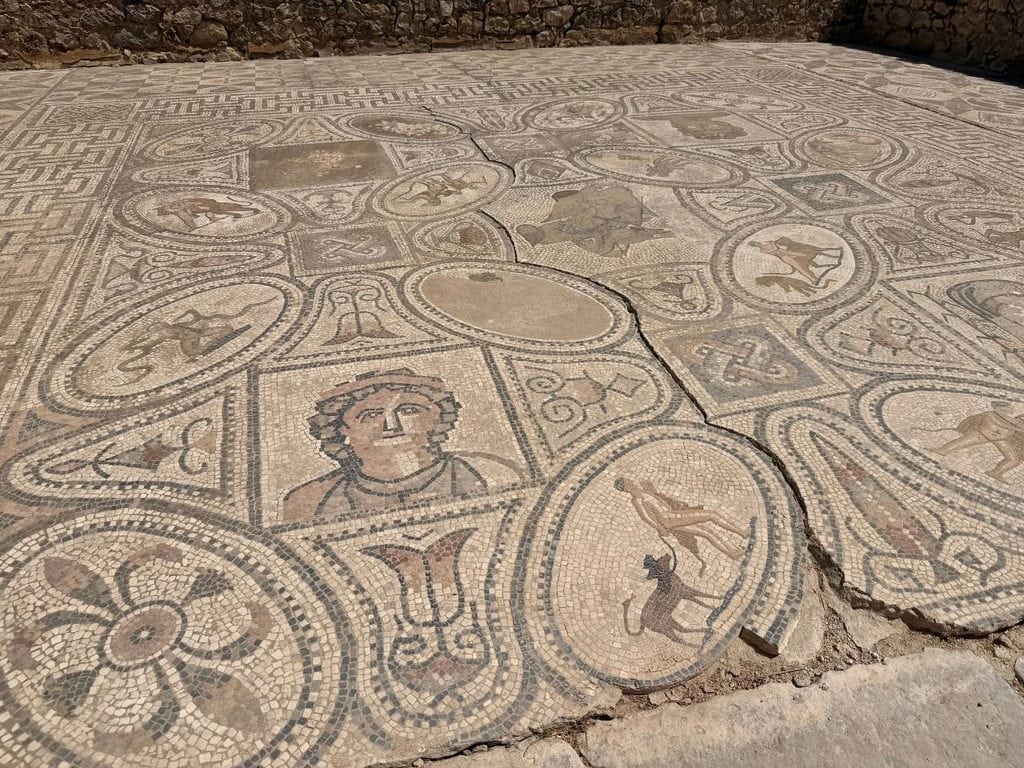
And then there were the mosaics.
They seemed to be everywhere.
Beautiful Roman mosaics remain right where they were created, open to the Moroccan sky.
I kept looking down as I walked, wondering how much ancient history was still underneath my feet.
Roman Houses, Baths and 2,000-Year-Old Engineering
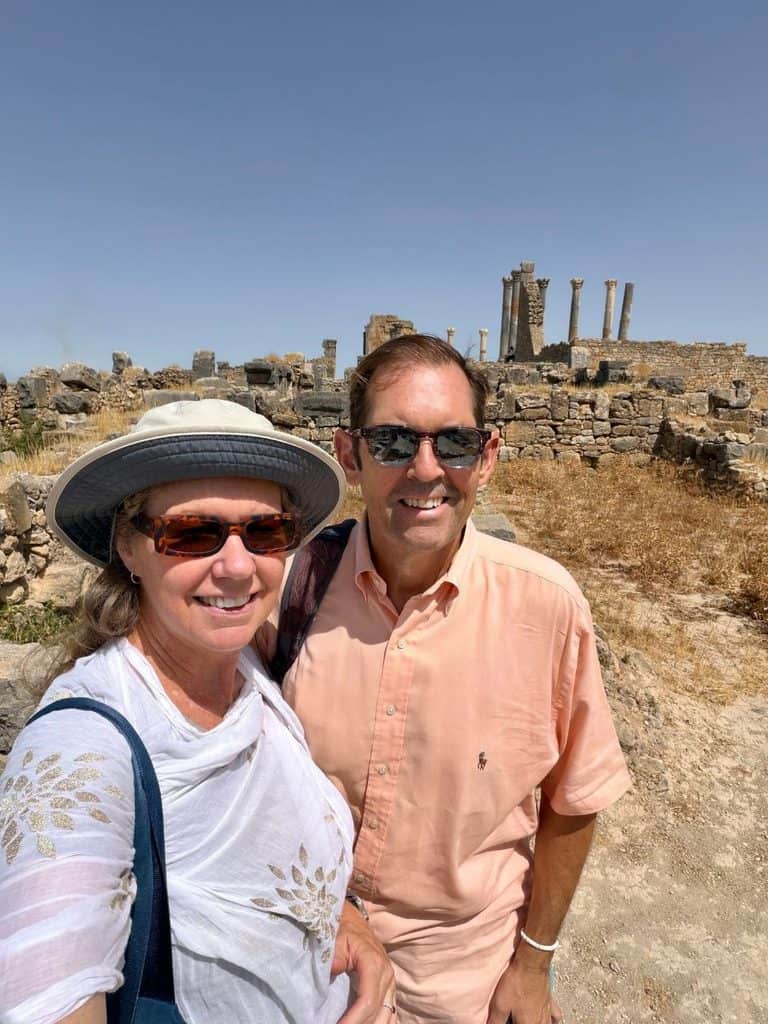
Because Rhett had already visited Volubilis twice, we skipped hiring an official guide and let him give us his unofficial tour.
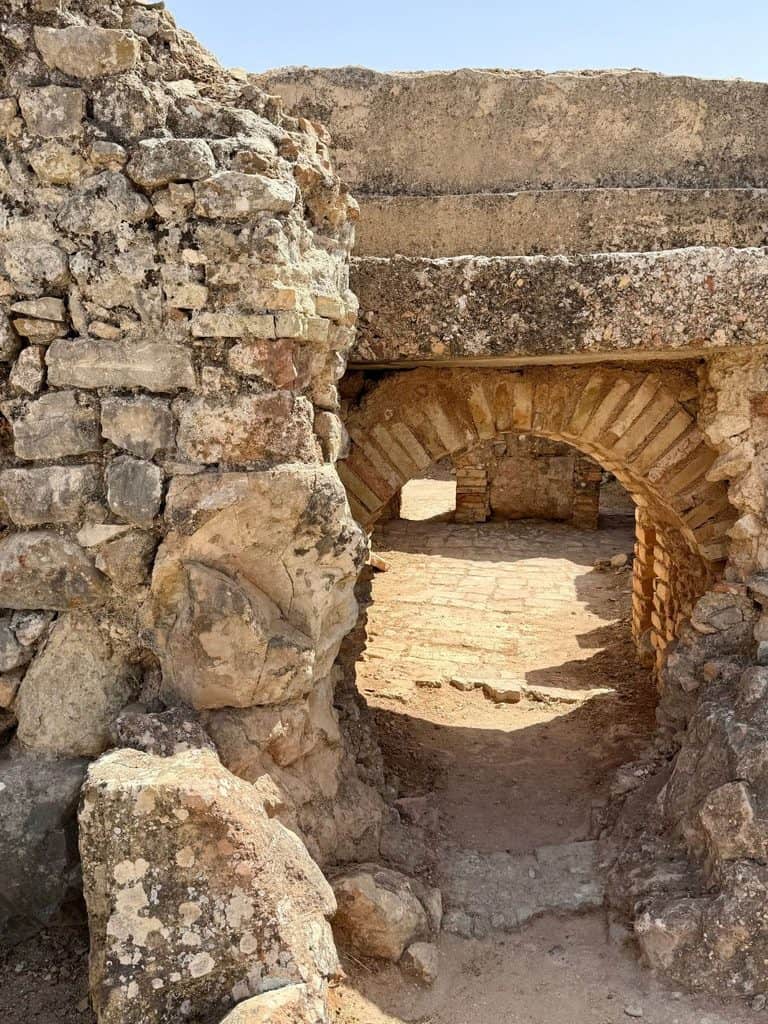
One of my favorite areas was the Roman bath complex.
I’ve visited Roman ruins in several countries, but the remains here made it particularly easy to understand how the Romans heated their bathing areas. Seeing the engineering exposed beneath what would once have been the floors helped bring the entire system to life.
Elsewhere we could distinguish between grand residential areas with enormous villas and more modest parts of the city.
Even the “less wealthy” neighborhood looked pretty good to me.
But the mosaics were the highlight.
There were so many of them, and so little separating us from them, that Volubilis sometimes felt less like visiting a museum and more like walking directly through an archaeological site.
Which, of course, is exactly what we were doing.
Almost Having Volubilis to Ourselves
Perhaps because it isn’t directly in one of Morocco’s biggest tourist cities, Volubilis wasn’t crowded when we visited.
We saw a few small groups who appeared to be European tourists, but for much of our visit it felt as though we had enormous sections of the ancient city almost to ourselves.
That made the experience even better.
We could take our time.
Nobody was rushing us.
And I could stop every few feet to take yet another photograph of a mosaic, column, arch, ancient street or olive grove.
This is exactly my kind of place.
If I return to this part of Morocco, I’ll go back.
Lunch Beside the Ruins
Before leaving, we stopped at the small restaurant near the entrance and ticket area.
I wasn’t expecting much.
Instead, we had fresh homemade pizzas on the patio, a surprisingly good ending to our morning among the Roman ruins.
Our driver had waited for us as arranged, and afterward we climbed back into the grand taxi for the return journey to Meknes.
The whole outing worked perfectly as a half-day trip.
An Evening in Rhett’s Neighborhood
Back in Meknes, we finally went to see Rhett’s apartment.
After spending the previous day seeing his school and walking through the city with him, it was nice to see the place he’d actually been calling home.
That evening, instead of heading back into the historic medina, we ate near his neighborhood at Katafish.
Seafood wasn’t necessarily what I’d expected to eat in inland Meknes, but it was surprisingly good.
It was also another nice change of pace.
One of the things I was beginning to appreciate about staying in Meknes was that not every experience had to be a “Morocco attraction.”
Sometimes we were simply visiting our son.
And that was the whole reason we’d come in the first place.
The following morning, however, we were tourists again.
We were heading to Fes.
Day 7: A Day Trip to Fes
Fes surprised me.
Before our trip, I’d read A House in Fez by Suzanna Clarke, and I’d created a picture in my mind of what the medina would look and feel like.
The reality wasn’t worse.
It was just completely different.
And even after wandering the medinas of Casablanca, Marrakech and Meknes, nothing had quite prepared me for the maze of Fes.
We made one transportation mistake getting there. We took a grand taxi from Meknes to Fes, which took more than an hour. We took the train back, which took only about half an hour.
Next time: train both ways.
Entering the Fes Medina at Bab Bou Jeloud
Our taxi dropped us directly in front of Bab Bou Jeloud, the famous blue gate and one of the main entrances into the Fes medina.
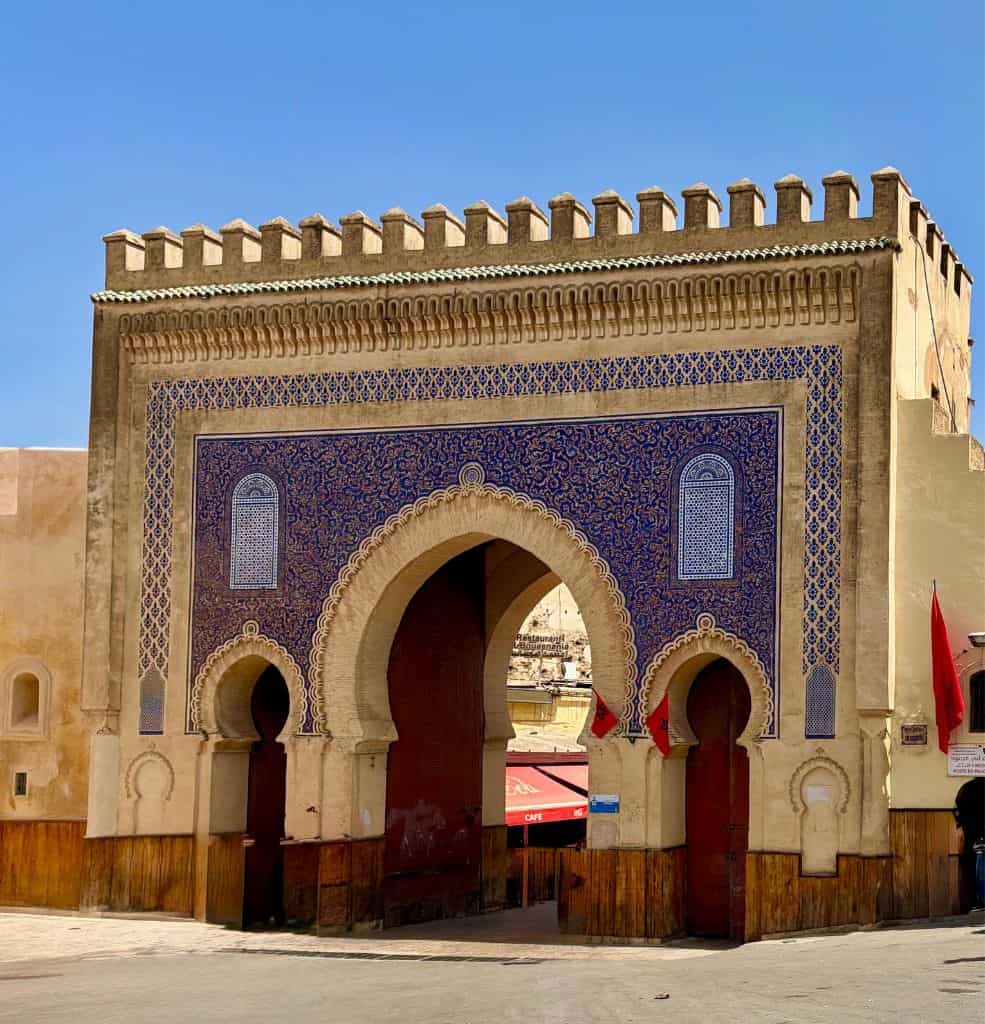
It was a perfect place to start.
Just inside the gate, the street was relatively wide and lined with vendors who immediately began trying to entice us into their shops. Within a few hundred yards, however, everything changed.
The streets narrowed.
Tiny alleys branched off in every direction. The medina climbed and descended with the hillside, and passageways that looked promising sometimes ended abruptly at another beautiful wooden door leading into someone’s centuries-old home.
We’d been warned about getting lost in Fes.
We got lost anyway.
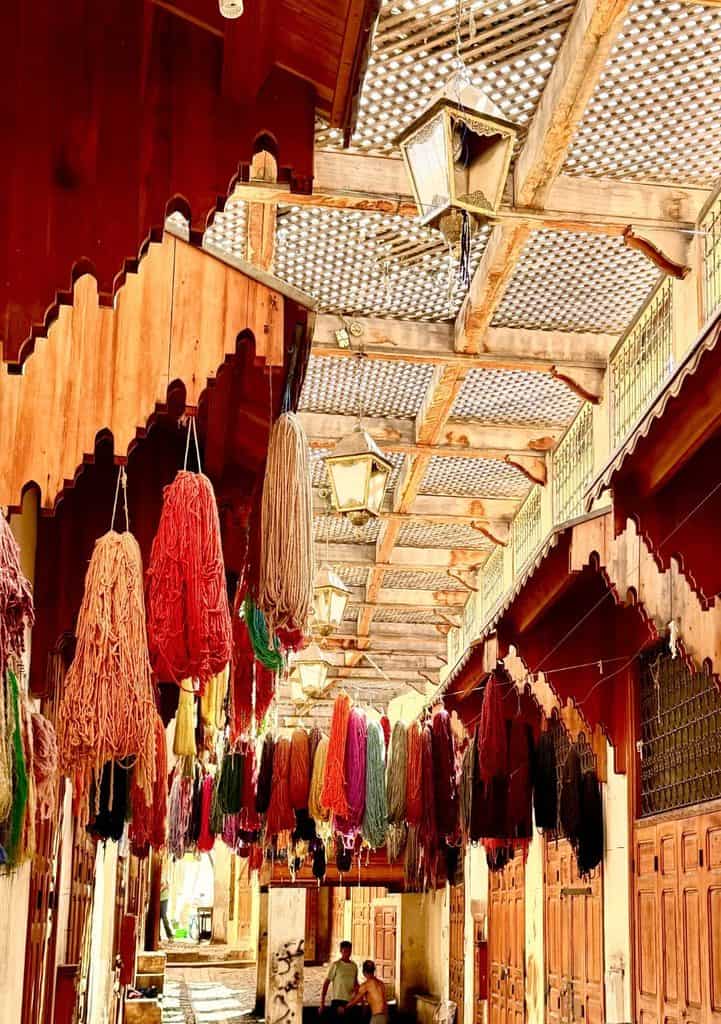
Trying to Find the Fes Tanneries
My must-see destination in Fes was the famous Chouara Tanneries.
We knew approximately where we were going. We also knew that people sometimes offer to “help” tourists find their way through the medina and instead lead them to shops belonging to friends or relatives.
We had been warned.
Twice.
And twice we followed someone anyway.
Both times, our helpful new guide somehow took such a complicated route that we had absolutely no idea how to retrace our steps. And both times we mysteriously ended up at someone’s shop rather than the tanneries.
Lesson learned.
Eventually.
I’ll admit that there were moments when the experience felt a little uncomfortable. I wasn’t particularly concerned for our safety, but if I’d been traveling alone, I probably would have turned around sooner rather than continuing down some of those increasingly narrow passages.
Finally, we began seeing leather shops.
Then we saw people standing outside holding bunches of fresh mint.
We’d found the tanneries.
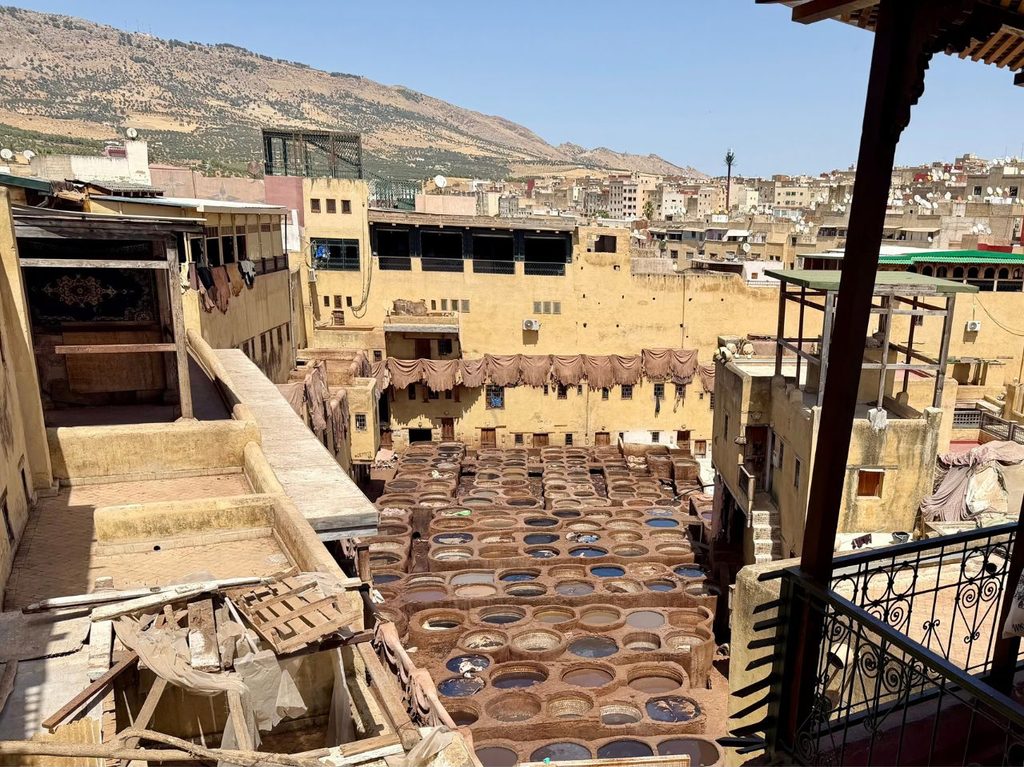
Seeing the Chouara Tanneries
Here’s something I hadn’t completely understood before visiting: getting the classic overhead view of the tanning vats generally means going through one of the surrounding leather shops.
We entered, wound our way upstairs through rooms overflowing with leather goods and eventually stepped onto a balcony overlooking the vats.
And suddenly, there they were.
It was Friday, which turned out to have advantages and disadvantages.
Nobody was working in the tannery, so our photographs of the vats don’t have workers in them. But it also meant the famous tannery smell wasn’t nearly as bad as I’d expected.
There was definitely a smell.
But with the fresh mint we’d been given to hold near our noses, it was completely manageable.
The leather shop itself was also worth exploring. Rhett’s girlfriend found a beautiful purse and put her newly acquired Moroccan bargaining skills to work.
Should You Visit Fes on a Friday?
This is one of those travel questions where I don’t think there’s one right answer.
Because Friday is the Muslim day of communal prayer, many of the shops in the medina were closed when we visited.
For someone who loves markets as much as I do, that was disappointing. We walked past hundreds of closed storefronts, with an occasional open shop scattered among them.
But there was an unexpected benefit.
We could actually move.
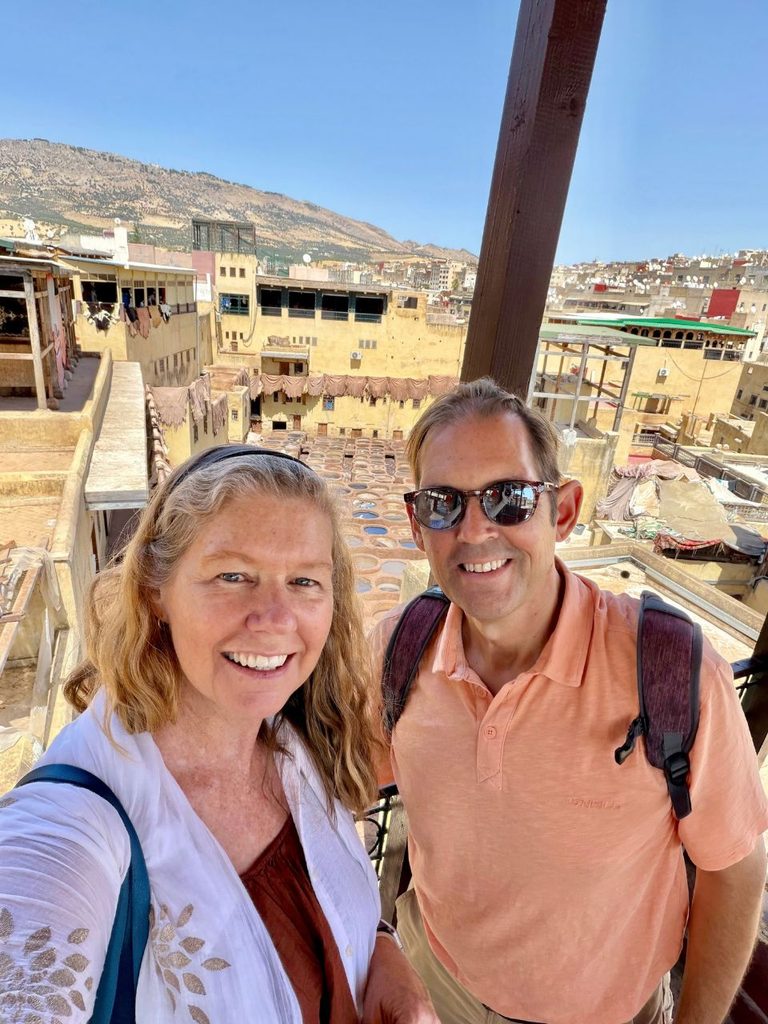
The passages through the Fes medina can be incredibly narrow. On a busy shopping day, covering 100 meters could take quite a while as you negotiate shoppers, vendors, carts, animals and everything else moving through the streets.
On Friday, we covered an enormous amount of the medina relatively quickly.
And because the stores that were open weren’t overwhelmed with customers, we had some wonderful conversations with shopkeepers.
Once again, Rhett’s Arabic opened doors.
People were genuinely surprised when he began speaking with them, and before long he was making friends and exchanging WhatsApp numbers.
One shopkeeper even left his store and personally walked us to a restaurant he recommended for lunch.
When we tried to tip him, he refused.
He simply wanted to make sure we found the place.
Another example of the kindness we experienced repeatedly in Morocco.
Would I Hire a Guide in Fes?
Probably not—but that’s a very personal choice.
Official guides were available near the entrance to the medina, and I can completely understand why many visitors hire one. Fes is confusing.
Really confusing.
But part of the fun for me is trying to figure these places out myself.
We got lost. We followed people we shouldn’t have followed. We reached dead ends. We wandered much farther than necessary.
And I still loved it.
If I returned as a solo female traveler, however, I might make a different choice and hire an official guide. Not necessarily because I considered Fes unsafe, but because having someone who knows that maze would make navigating some of the quieter passages more comfortable.
And I absolutely want to return someday when the entire market is open.
I want the chaos.
Back to Meknes by Train
By mid-afternoon we’d seen enough for one day and took petit taxis to the Fes train station.
This time, we didn’t have advance tickets.
It didn’t matter.
The station was busy but easy to navigate. We found a ticket kiosk, purchased four one-way tickets to Meknes and were aboard a train in less than 15 minutes.
About half an hour later, we were back in Meknes.
If I were doing this day trip again, I’d take the train in both directions.
Day 8: Our Final Morning in Meknes
By our last morning, Meknes had become one of my favorite surprises of the entire trip.
We took one final walk through its medina, including the wonderful section filled with honey and sweets, before visiting the small Meknes Museum near our riad.
Our hotel, Riad Zidania, couldn’t have been better located for what we wanted. We were near Bab Mansour and directly across the alley from the Mausoleum of Moulay Ismail, right in the historic heart of Meknes.
I’d chosen the riad because, for once, I didn’t want a Marriott.
I wanted to sleep inside history.
And that’s exactly what we did.
Then, far sooner than I wanted, it was time to leave.
We said quick goodbyes to Rhett and his girlfriend, hugged them and climbed into a petit taxi bound for the train station.
Gary and I were heading back to Casablanca.
Rhett was staying behind in Meknes.
And suddenly the reason we’d come to Morocco in the first place was standing on the sidewalk as our taxi drove away.
Day 9: Back to Casablanca
Our final train journey took about three hours, retracing our route west toward Casablanca.
By now, Morocco’s trains felt familiar.
We’d gone from carefully printing backup copies of every ticket before the trip to confidently navigating stations, buying tickets from machines and hopping aboard.
That’s one of my favorite things about travel: somewhere that felt completely unfamiliar 10 days earlier can suddenly feel surprisingly manageable.
Because our flight to Los Angeles departed at 4 a.m., we’d booked a room at the Relax Hotel near Mohammed V International Airport for our final night.
This was absolutely the right decision.
We arrived after dark following a long travel day, and neither of us had any interest in heading back into Casablanca to squeeze in one final sightseeing experience.
We ate a quick snack at the hotel, attempted to sleep for a little while and caught the hotel shuttle at 1:30 a.m.
Sleep didn’t really happen.
But at least we tried.
Day 10: The Journey Home
One Last Casablanca Airport Tip
Our shuttle dropped us near the same part of the airport where we’d caught our taxi on that dark first morning in Morocco.
There was just one problem.
Our flight to the United States was leaving from Terminal 1, farther down the airport complex.
We had plenty of time and the walk wasn’t particularly difficult, but it’s something I’d check in advance next time.
If you’re arriving at Mohammed V International Airport by taxi, check your departure terminal before you leave your hotel and ask your driver to take you to the appropriate entrance.
At that hour, the airport was quiet and not much was open, although we found a coffee shop. The terminal and bathrooms were clean, check-in was straightforward and our flight left on time.
We boarded the nonstop flight back to Los Angeles.
Ten days earlier, we’d arrived in Morocco in the dark without really knowing what to expect.
Now we were leaving with hundreds of photos, a suitcase full of memories and an entirely new list of places I wanted to see next time.
Rabat was already near the top.
Would I Recommend This 10-Day Morocco Itinerary?
Absolutely.
More importantly, I wouldn’t try to add much more to it.
It’s tempting when planning Morocco to squeeze in another city, another tour or another overnight stop. I’m glad we didn’t.
We had one full day in Casablanca, three nights in Marrakech and several days based in Meknes, with side trips to Volubilis and Fes. We traveled primarily by train, walked miles through medinas, wandered without plans, bargained in souqs, rode camels, explored Roman ruins, ate wonderful food, and even spent an afternoon doing absolutely nothing beside a hotel pool.
It never felt like a checklist.
For me, that was what made this itinerary work.
What Would I Change?
Very little.
I’d take the train instead of a grand taxi from Meknes to Fes.
I’d try to visit Fes on a day other than Friday so I could experience the medina when all of its shops were open.
I’d reserve the hammam at the Hassan II Mosque complex in Casablanca.
And someday, I’d add Rabat. Looking at it through the train window wasn’t enough.
But I wouldn’t sacrifice time in Meknes to do it.
Marrakech was spectacular, colorful and exciting. Fes was fascinating. Casablanca was the perfect introduction.
But Meknes was where I felt as though I was beginning to see another side of Morocco.
Maybe that’s because our son lives there.
Maybe it’s because we stayed inside the walls of the historic city, wandered a souq where we rarely saw another tourist, celebrated alongside local families in Place el-Hedim and used it as our base for exploring Volubilis and Fes.
Probably all of the above.
Whatever the reason, Morocco completely won me over.
And ten days wasn’t nearly enough to satisfy my curiosity.
It was enough to make me want to go back.
More Morocco is coming! Planning your own trip? Join my email list and I’ll send you my newest Morocco guides as I publish them.
More Morocco is Coming
Planning your own trip? Join my email list and I’ll send you my newest Morocco guides as I publish them.
Send Me the Morocco Guides →
