
Before our trip to Morocco, train travel was one of the things I researched the most. I bought our tickets online ahead of time, printed paper copies just in case, and wondered how easy it would actually be to navigate the stations once we arrived.
It turned out that Morocco train travel was one of the easiest parts of our entire 10-day trip.
We traveled by train from Casablanca to Marrakech, Marrakech to Meknes, Fes to Meknes and finally Meknes back to Casablanca. We bought first-class tickets, navigated several different stations, traveled with carry-on luggage and even tackled a six-hour journey across the country.
And by the end of the trip, there was one transportation decision I would definitely change: I would have taken the train to Fes instead of a grand taxi.
If you’re considering traveling around Morocco by train, here’s exactly what we learned, including how we bought tickets, what the stations were like, whether first class was worth it and what I’d do differently next time.
Planning your Morocco itinerary, too? Here’s our complete 10-day Morocco itinerary through Casablanca, Marrakech, Meknes, Fes and Volubilis.
Is Train Travel in Morocco Easy?
For us, yes. Morocco train travel was surprisingly easy.
Before our trip, I wasn’t quite sure what to expect. Would the stations be confusing? Would we know which platform to use? Would our online tickets actually work? Would there be room for our luggage?
As it turned out, we had very few problems.
Morocco’s passenger trains are operated by ONCF, and we used the train for most of our longer journeys between cities. We purchased most of our tickets online before leaving home, received tickets with QR codes and simply showed them when entering the station or boarding the train.
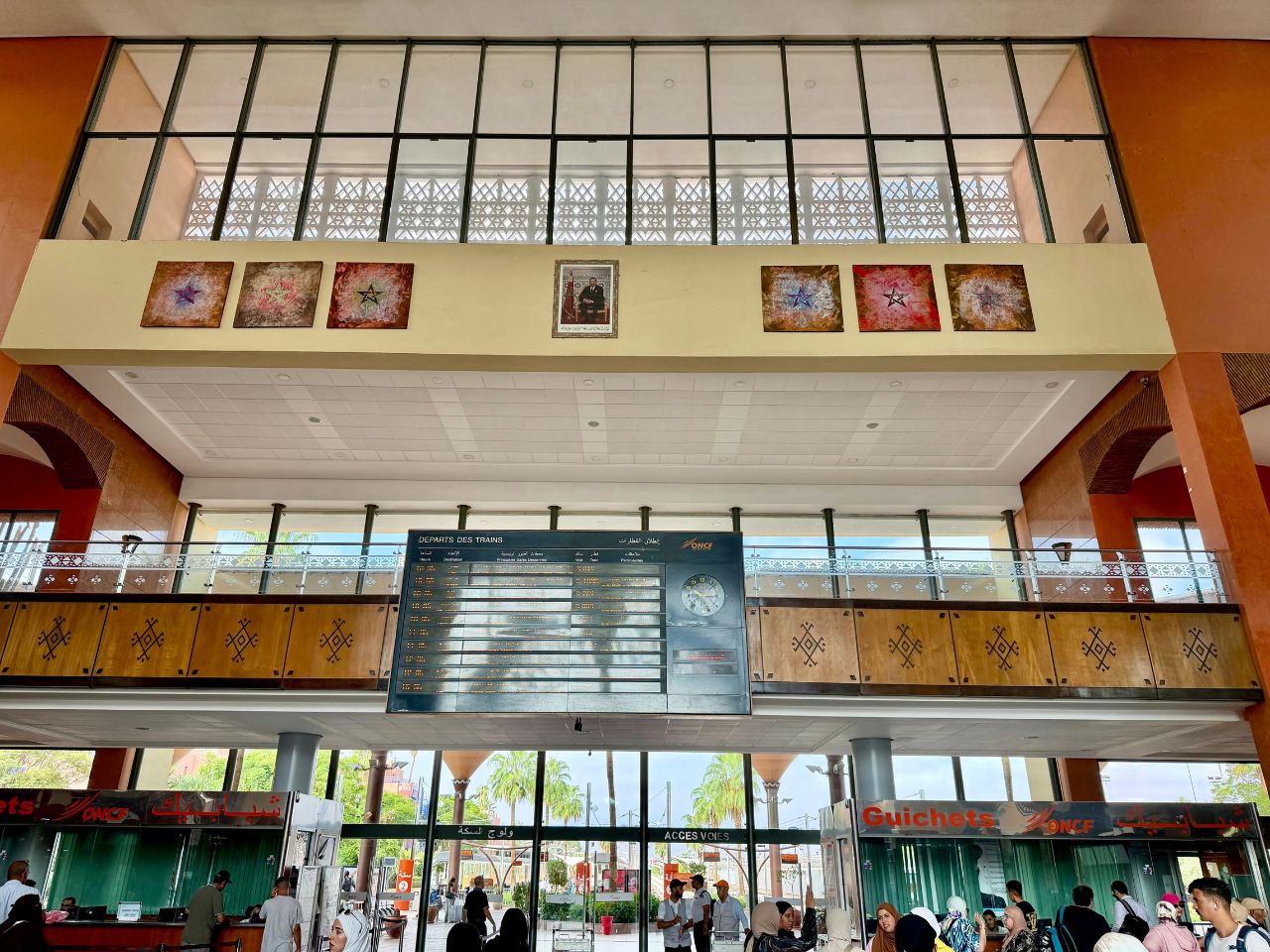
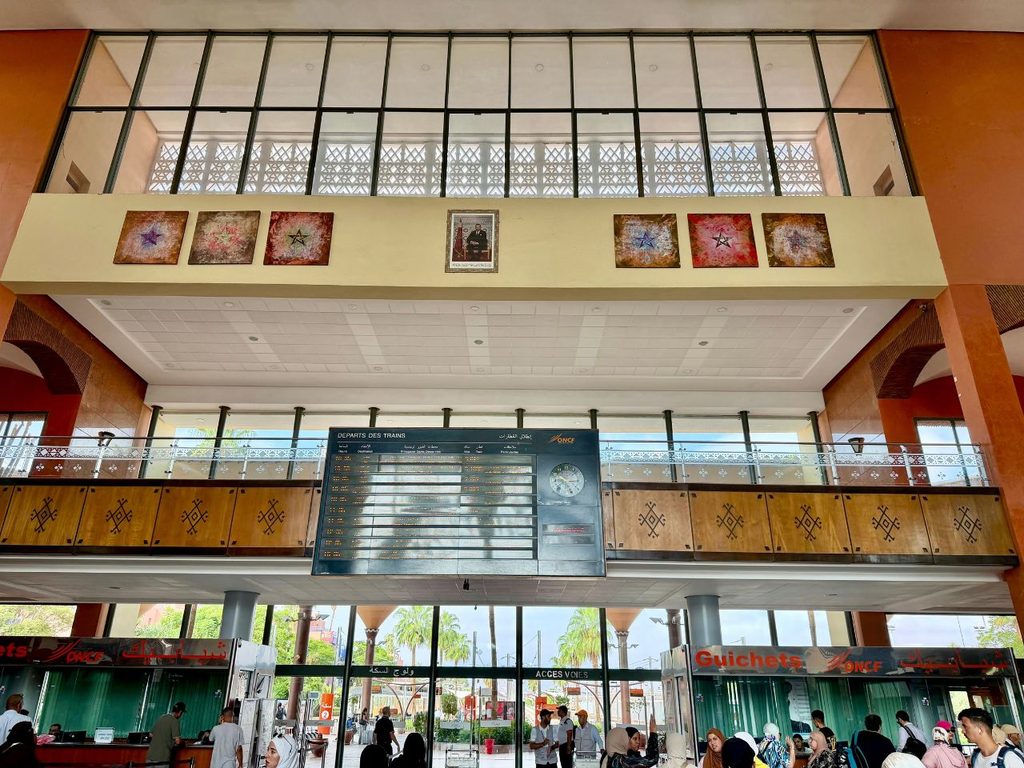
The larger stations we used were modern and easy to navigate, with electronic departure boards, cafés and other shops, bathrooms and ATMs. Announcements and signs weren’t always in English, but we never found that to be a major obstacle.
We also traveled with carry-on luggage only, which made getting on and off trains especially easy. If you’re traveling Morocco with large suitcases, your experience may be a little different, and I’ll talk more about luggage below.
After several train journeys, including one that lasted more than six hours, I’d happily use Morocco’s trains again.
Affiliate Disclosure: This post contains affiliate links. If you make a purchase or booking through one of these links, I may earn a small commission at no additional cost to you. As an Amazon Associate I earn from qualifying purchases.
How to Buy Morocco Train Tickets
We bought our Morocco train tickets online before our trip through ONCF, Morocco’s national railway operator.
After purchasing the tickets, we received electronic tickets with QR codes. I also printed paper copies before leaving home because…well, I’m a traveler who likes a backup plan.
We never needed them.
At the stations, we simply pulled up the tickets on our phones and showed the QR codes when required. At Casablanca Voyageurs train station, for example, a guard checked our tickets before we were allowed through to the platforms.
Buying ahead also meant we weren’t standing at a ticket machine trying to figure everything out while a train was about to leave.
Later in the trip, however, we also bought tickets at the station in Fes, and that was easy, too. We purchased them from a kiosk and were quickly on our way.
Should You Buy Morocco Train Tickets in Advance?
We bought most of our train tickets before leaving for Morocco, and I would do the same again, especially for the longer journeys when we wanted to travel first class.
ONCF allows travelers to buy tickets online as e-tickets, as well as at ticket counters and machines in the stations. ONCF’s website also recommends purchasing in advance to help secure a seat and take advantage of available fares.
For us, buying ahead simply removed one more thing we had to think about during the trip. We already knew which train we were taking, what time we were leaving and which class we had booked. It also made it easy to choose our seats, so we were sitting next to each other, in the same compartment.
That said, you don’t necessarily need to purchase every ticket before you arrive in Morocco.
When we decided to take the train from Fes back to Meknes, we bought our tickets at the station and boarded shortly afterward. It was incredibly easy.
My advice: If you already know your itinerary (particularly for a longer travel day or a train you really want to take) I’d buy the ticket in advance. If your plans are more flexible, buying tickets at the station can work, too.
First Class on Morocco Trains: Is It Worth It?
For us, absolutely.
Our first-class tickets were surprisingly affordable compared with train travel in many other countries. For example, our approximately three-hour trip to Marrakech cost us about $27 per person at the time of our trip.
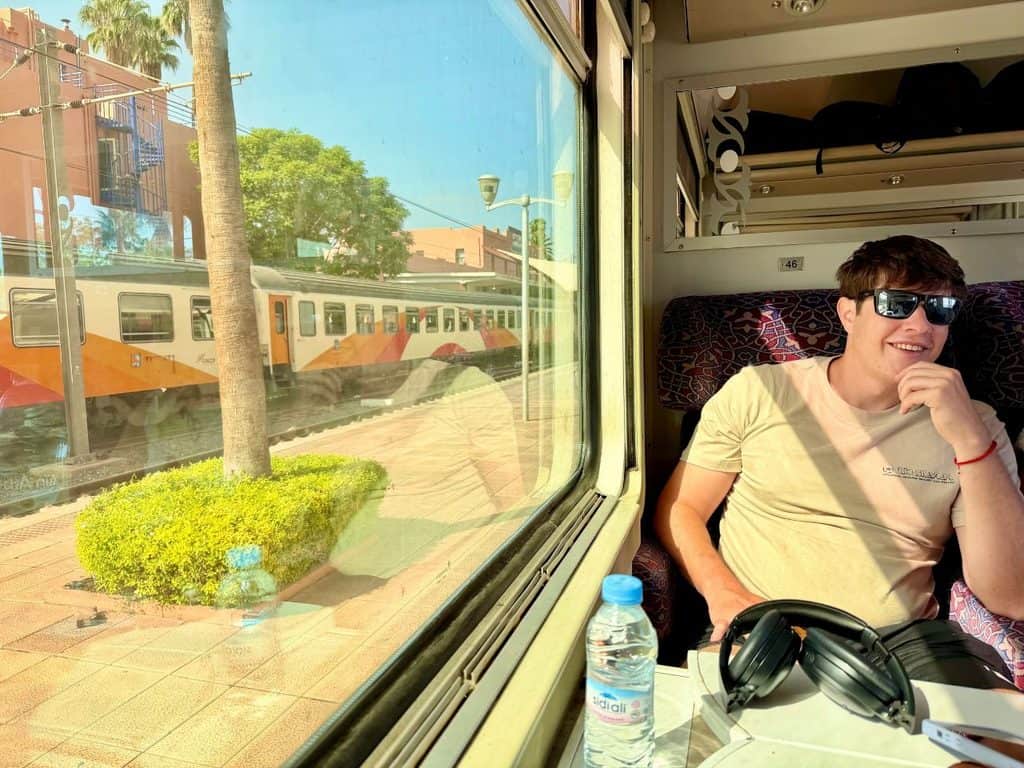
On that journey, first class consisted of compartments with six seats (three facing three). Four of us were traveling together, and two other passengers occupied the remaining seats.
It wasn’t luxurious, but it was comfortable and clean, and for the relatively small difference in price, we were happy we’d chosen first class.
Second-class seats can be reserved on ONCF’s Al Atlas trains as well, so you don’t need to travel first class simply to have a reserved seat.
On longer journeys, I appreciated it even more. Our train from Marrakech to Meknes took more than six hours, so having a reserved seat and a little more comfort mattered.
There was also a cart that came through the train selling drinks and snacks. I ordered mint tea, which somehow seemed like the appropriate choice while watching Morocco pass by outside the window.
Would I pay for first class again? Yes. Especially on a journey of several hours.
What Are Morocco Train Stations Like?
One of my questions before traveling was what the train stations themselves would be like. Would they be easy to navigate? Would we know where to go? Would there be places to grab food or use an ATM before boarding?
At least at the larger stations we used, the experience was much easier than I expected.
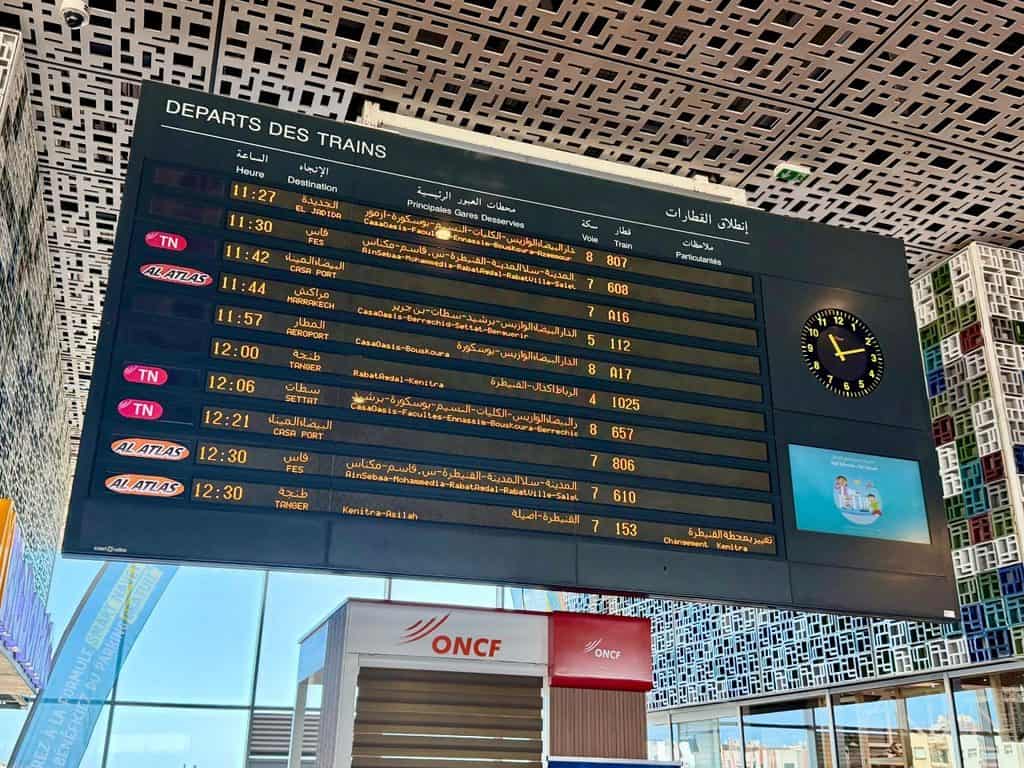
Casablanca Voyageurs, where we caught our train to Marrakech, felt like a modern transportation hub. Inside were places to buy food and drinks, shops, bathrooms and banking services. Large electronic departure boards displayed upcoming trains and departure times, making it fairly easy to figure out where we needed to go.
We already had our tickets on our phones, so we showed the QR codes at the checkpoint before heading toward the platforms. I had also printed our tickets before leaving home, but those paper copies stayed tucked away in my bag for the entire trip.
Our train was running a few minutes late, which was clearly shown on the departure board. Once the platform was announced, we headed downstairs and made our way to the train.
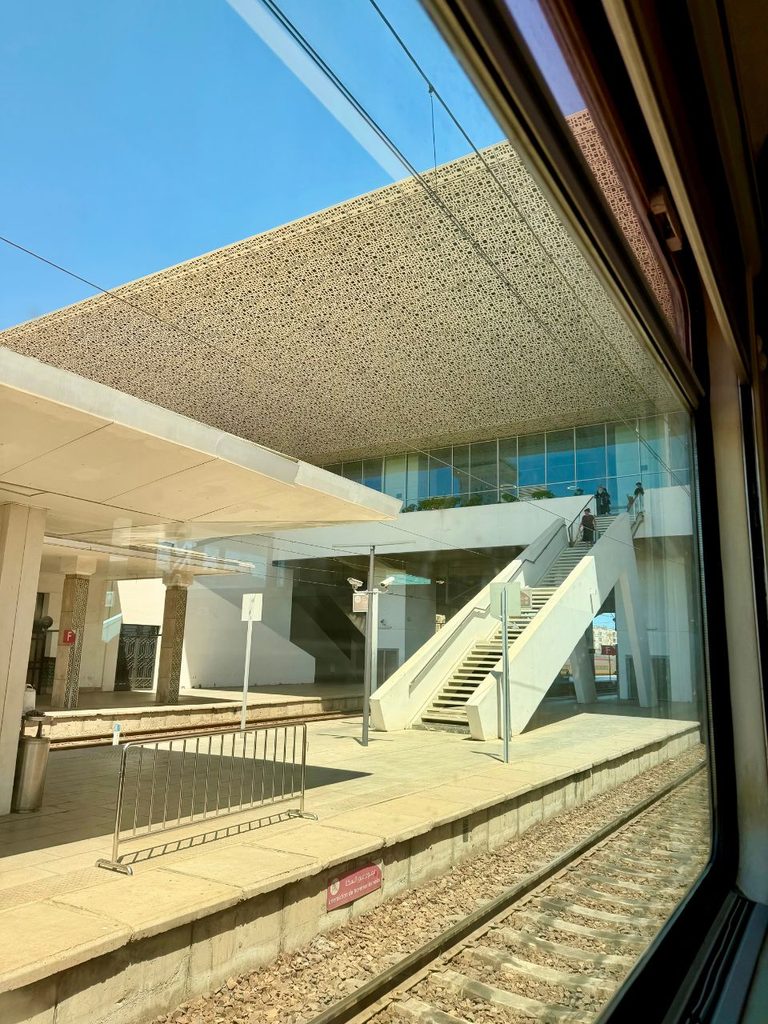
We used several stations during our 10 days in Morocco, and although they varied in size, we never found the process particularly intimidating. By the end of the trip, arriving at a station and catching a train felt completely routine.
Are Morocco Train Stations Easy to Navigate?
In our experience, yes. Give yourself enough time to find the departure board, check your train and platform, and get through any ticket checkpoint without rushing. We generally found the larger stations straightforward to navigate, even though not everything was displayed in English.
Traveling Morocco by Train With Luggage
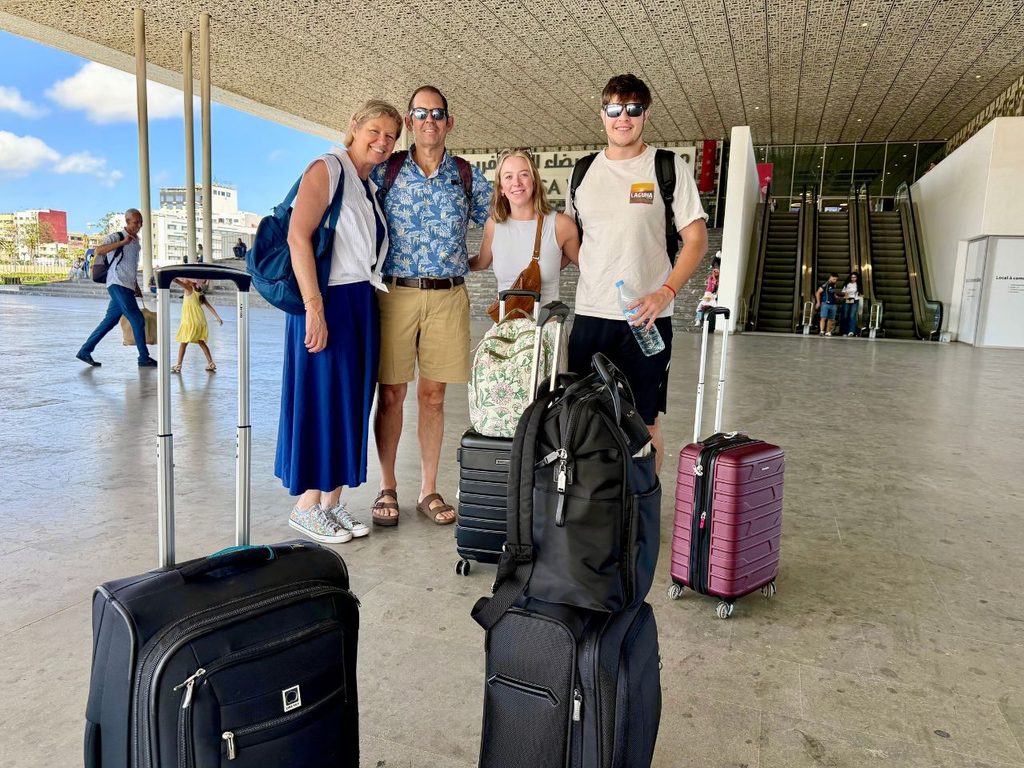
If you’re planning to travel around Morocco by train, my biggest luggage advice is simple: pack as lightly as you can.
For our 10-day trip, I traveled with one small roller carry-on and a medium-sized Baggallini travel backpack. My roller was small enough to fit in the overhead compartments on both our flights and every train we took in Morocco.
My backpack was designed for travel and had a sleeve on the back that slipped over the extended handle of my roller bag. That meant that while walking through airports and train stations, I could essentially manage all of my luggage with one hand.
That turned out to be incredibly convenient.
Where Do You Put Luggage on Morocco Trains?
My small carry-on fit easily in the overhead storage inside our train compartments. I never worried that it was too large, that I wouldn’t find a place for it or that it might fall down on us during the journey.
We saw firsthand why traveling with a large suitcase could be more difficult.
On one of our trains, another passenger had a suitcase that was much too large to fit overhead or comfortably inside the compartment. She had to leave it in the hallway outside.
That became awkward whenever people needed to pass, particularly when the train stopped at stations and passengers were getting on and off. It became even more of an obstacle when the food cart needed to make its way through the train.
Could you travel Morocco by train with a large suitcase? Of course. But after our experience, I would choose a small roller bag every time.
It was also much easier when we encountered stairs. Many of the stations we used had escalators, but not every part of every journey was step-free. A small carry-on was easy for me to lift up or down stairs and onto the train itself.
How I Packed for 10 Days in a Carry-On
This trip was also the first time I tried reusable compression bags. I’m now a convert.
The set I bought came with a small rechargeable vacuum pump that removes the air from each bag. I used separate compression bags for different portions of our trip: one for Casablanca, another for Marrakech and so on.
When we arrived at a new destination, I could simply pull out the bag I needed and hang up those clothes. When it was time to leave, everything went back into the compression bag, I removed the air again, put that packet at the bottom of my suitcase and moved on to the next one.
It kept me surprisingly organized while we were changing hotels and cities.
More importantly, the compression bags saved enough room that I could fit my clothes, two pairs of shoes and my cosmetics bag into one small roller carry-on.
I’ll absolutely use them again.
These are the reusable compression bags I used for Morocco, and the set includes the rechargeable pump I traveled with.
What I Kept in My Backpack
I treated my backpack differently from my suitcase. It contained the things I wouldn’t want to be without if my roller bag and I somehow became separated:
- an extra set of clothes, including underwear, a T-shirt & non-wrinkle travel pants
- iPad and noise-canceling headphones
- eyeglasses, sunglasses
- phone, chargers
- passports & travel information
Inside the backpack I also packed a lightweight zippered Baggallini tote that compressed to almost nothing.
Once we arrived in a city, that became my everyday bag. I used it like a purse, but it was large enough to hold the things we accumulated during the day: snacks, purchases from the souqs and even the cordless fans we carried because of the August heat.
On train days, I emptied the tote, folded it up and put it back inside my backpack.
It was a simple system:
Small roller = clothes and toiletries.
Backpack = valuables and things I needed while traveling.
Packable tote = everyday sightseeing bag.
And because the backpack slipped over my roller handle, I could move through a station with everything essentially consolidated into one piece of luggage.
Can You Travel Morocco With Just a Carry-On?
For us, absolutely.
In fact, traveling by train made me even happier that we’d packed lightly. We changed cities several times during our 10-day trip, so we were constantly moving luggage between hotels, taxis, stations and trains.
I didn’t want to spend the trip wrestling with a huge suitcase.
If you’re planning a similar multi-city Morocco itinerary, packing light is one of the best pieces of advice I can give you.
The Morocco Train Routes We Took
During our 10 days in Morocco, we used trains for four different journeys. Some were short and easy, while one took more than six hours and gave us a much better sense of just how large Morocco is.
Here’s what each journey was actually like.
Casablanca to Marrakech by Train
Our first train journey was from Casablanca to Marrakech, and it was the perfect introduction to Morocco train travel.
We took a Grand Taxi from our hotel to Casablanca Voyageurs station. Because we’d purchased our tickets ahead of time, there was no need to stop at a ticket counter. We showed our QR codes at the checkpoint, found our platform and waited for the train.
The journey took about three hours. We traveled first class in a six-seat compartment, with three seats facing three. There were four of us traveling together, so two other passengers shared the compartment with us.
A food cart came through during the journey selling tea, coffee, soft drinks and snacks. Naturally, I ordered tea.
But one of my favorite parts of the trip was simply looking out the window.
After spending our first day in busy Casablanca, I loved watching the landscape change as we traveled toward Marrakech. It was our first chance to see some of Morocco beyond the cities we were visiting.
Would I take this train again? Absolutely. It was inexpensive, comfortable and much easier than I had imagined before the trip.
Marrakech to Meknes by Train
This was our big train day.
Traveling from Marrakech to Meknes took us more than six hours because the route brought us back through Casablanca before continuing north and east toward Meknes.
It was a long journey, but this was also when I was especially glad we’d booked first class. We had comfortable seats, our luggage was easily stored overhead and we could settle in for the day rather than worrying about driving or navigating between cities.
One unexpected bonus was passing through Rabat. We didn’t include Morocco’s capital in this trip, but what I saw through the train window was enough to put it firmly on my list for next time.
By the time we arrived in Meknes, we were ready to get off the train. But I still preferred spending six hours on the train to dealing with a long road transfer.
Fes to Meknes by Train
This was our shortest train journey, and the one that taught us a lesson.
We had traveled from Meknes to Fes by Grand Taxi, which took more than an hour. For the return trip, we decided to take the train instead.
What a difference.
We bought our tickets at the station in Fes, boarded shortly afterward and were back in Meknes in roughly half an hour.
If I were doing the trip again, I’d take the train in both directions.
The Grand Taxi experience wasn’t bad or uncomfortable, and I’m glad we tried different forms of transportation in Morocco. But between these two cities, the train was simply easier for us.
Meknes to Casablanca by Train
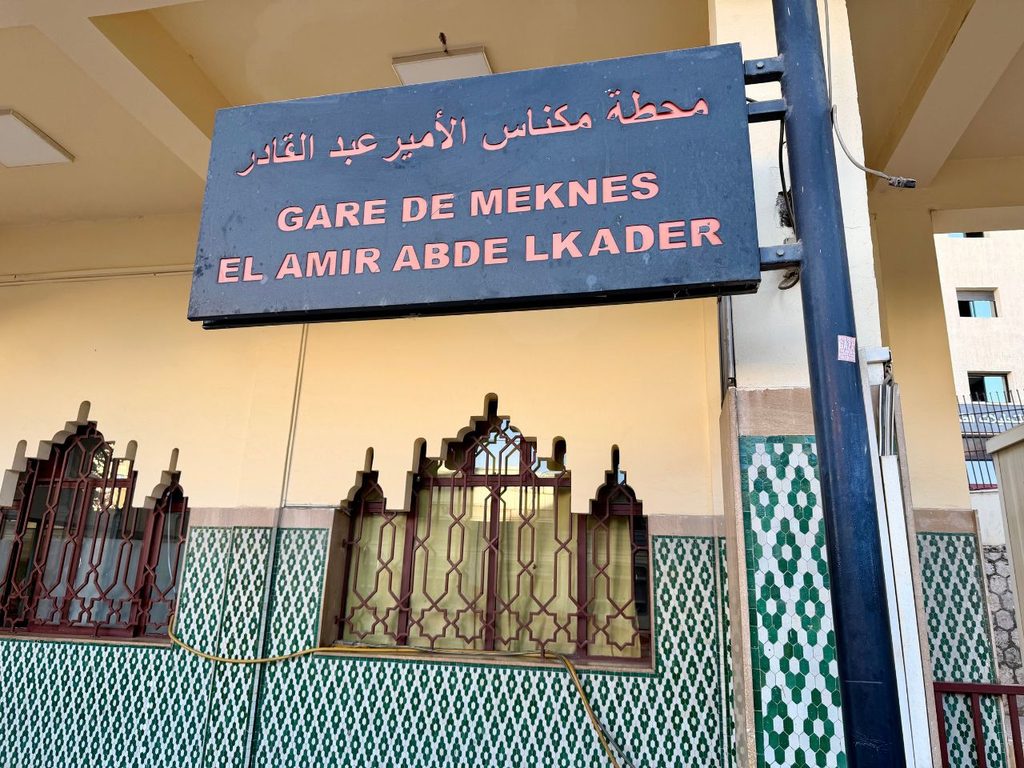
Our final train journey took us from Meknes back to Casablanca at the end of the trip.
By then, the process felt completely routine: petit taxi to the station, luggage through the station, find the train, get settled and go.
That’s probably the best endorsement I can give Morocco’s trains.
Something that had seemed like one of the bigger logistical questions before our trip had become one of the easiest parts of traveling around the country.
Morocco Train vs. Grand Taxi: Which Would I Choose?
During our trip, we used both trains and Grand Taxis to travel between destinations, and I wouldn’t say that one is always better than the other.
It really depends on where you’re going.
For travel between major cities connected by rail, I generally preferred the train. It was comfortable, inexpensive, easy to navigate and meant we could sit back and relax rather than spend several hours on the road.
Our trip between Meknes and Fes was the perfect comparison.
We took a Grand Taxi from Meknes to Fes, and the drive took more than an hour. When it was time to return, we decided to try the train instead. We bought tickets at the Fes station and were back in Meknes in roughly half an hour.
If I did that day trip again, I’d take the train both ways.
But Sometimes a Grand Taxi Is the Better Choice
Volubilis was completely different.
There wasn’t a train that could take us directly to the ancient Roman site, so we hired a Grand Taxi in Meknes instead. We negotiated with the driver to take us to Volubilis, wait while we explored the ruins and then drive us back to Meknes.
It was easy, reliable and actually a fun part of the day.
That’s one of the things I learned about transportation in Morocco: you don’t have to choose one method for your entire trip.
We used trains for the longer journeys where rail made sense, petit taxis for short trips around cities and Grand Taxis when we needed to travel somewhere the train didn’t conveniently reach.
For our itinerary, that combination worked extremely well.
If two cities were conveniently connected by train, I’d choose the train. If we were heading somewhere outside the rail network, like Volubilis, I was perfectly happy to use a Grand Taxi.
Planning to visit Volubilis? I’ll be publishing a complete guide to our Volubilis day trip from Meknes soon.
Morocco Train Travel Tips I Wish I’d Known
After taking several trains across Morocco, there are a few things I’d tell anyone planning to do the same.
- Buy longer journeys ahead of time. We liked knowing our longer travel days were already arranged, particularly when we wanted first-class tickets. For shorter trips, buying at the station worked well for us.
- Keep your ticket on your phone. Our electronic tickets and QR codes were all we needed. I printed backup copies before leaving home, but never used them. We found reliable Wi-Fi in the train stations we used, but I’d still recommend downloading or taking a screenshot of your ticket before arriving at the station.
- Pack light if you can. This might be my biggest tip. Small roller bags fit easily overhead and were simple to carry up stairs, lift onto trains and maneuver through stations.
- Arrive with enough time to check the departure board. We found the stations fairly easy to navigate, but I would still rather have a few extra minutes than be rushing to figure out a platform.
- Consider first class for longer trips. You don’t need first class simply to have a reserved seat on Al Atlas trains, but we appreciated the additional comfort—especially during our six-plus-hour journey from Marrakech to Meknes.
- Bring water and a snack. We encountered food and drink carts on the trains, but I wouldn’t rely on them for everything I might want during a long journey.
- Don’t assume the train is always the best option. For destinations such as Volubilis, a Grand Taxi made much more sense. We mixed trains, Grand Taxis and petit taxis throughout the trip.
- Look out the window. This sounds silly, but don’t spend the entire journey on your phone. Some of my favorite moments were simply watching Morocco go by.
Would I Travel Morocco by Train Again?
Absolutely.
Before our trip, Morocco train travel was one of the logistical details I spent time researching because I wasn’t quite sure what to expect.
By the end of our 10 days, catching a train felt completely routine.
We found the stations easy to navigate, our electronic tickets worked without a problem, first class was comfortable and affordable for us, and traveling with small carry-on bags made moving between trains and stations remarkably easy.
More importantly, traveling by train allowed us to see Morocco in a way that flying between cities never would have.
We watched the scenery change between Casablanca and Marrakech, passed through Rabat on our long journey to Meknes and gradually became comfortable enough with the system that we bought tickets in Fes and hopped on a train back to Meknes without giving it much thought.
If I were planning the same trip tomorrow, I’d use the trains again. And I’d probably use them even more.
Planning your own Morocco trip? See how we connected all of these train journeys in my complete 10-Day Morocco Itinerary.
More Morocco is coming! I’m publishing more firsthand guides to Marrakech, Meknes, Fes, Volubilis, packing and more. Join my email list and I’ll send you the newest Morocco guides as I publish them.
